13 November 2008
A rather annoying hidden charge
I have a ridiculously featureless cellphone here -- it's beyond basic, but I like it for exactly that reason. I don't have a contract, I just put more credit on it when I need to, which is a variable sort of thing. But. I am annoyed that it costs a one-time fee of €11.62 in order for me to activate caller ID. Nice one, Orange.

12 November 2008
"Prosím si kavu"
This topic was bound to come up eventually, no? The truth is, I don't really drink a lot of coffee here, but today as I was waiting for the train I got some because I was eating something rather sweet but fruity (lunch leftovers!) and the taste was too complementary to pass up. Normally in the convent I drink weak tea with meals (weak tea is a really common way of serving tea here, not just in the convent) and in the zbrovňa I drink Earl Grey as strong as I can make it.
But coffee the world over is a varied, but ritual act.
Here, when one goes out for coffee (Slovakia is rather blissfully void of Starbucks), the nicest choice is a kaviareň. This is a coffeehous where one gets coffee and effectively rents space in a pleasant 19th century type of environment to gather with one's crew, drink coffee, and perhaps nibble on some pastries. A good choice in a kaviareň is a Viennese coffee (we are, after all, in the former Austro-Hungarian Empire).
At a bufet, which is often a kiosk on the street or a hole in the wall of the train station, where one can buy shots of alcohol, sandwiches and other small food items, but also sometimes at home, the common method for making coffee is to put ground coffee in a glass and pour hot water over it. This results in the so-called classic style, a non-nuanced version of Turkish coffee. Thus, when one goes to a kaviareň and seeks to avoid such a thing, it is appropriate to ask for an espresso.
In the zbrovňa, the overwhelming favorite is instant coffee, though nearly everyone drinks both coffee and tea, depending on their disposition and also quite possibly, the weather. The refrigerator usually has some dubiously fresh milk, though sometimes there are also individual creamers, whcih are UHT milk and therefore not likely to be of dubious freshness. Usually each teacher keeps their own coffee, tea and sweetening agent, though morale and camraderie are high so sharing occurs rather liberally. For example, consider the following dialogue which took place today between two normally-tea-drinking colleagues:
Wow. Look how quickly I get off track and on to bacon! Finally, there's my big guilty coffee pleasure, which are the delightfully utilitarian automat coffee machines. They are delightfully utilitarian because it is obvious that the coffee formula has been scientifically standardized to create a near-unanimously agreeably favorable taste.
So alas, a visual summary (as always, click to enlarge):

But coffee the world over is a varied, but ritual act.
Here, when one goes out for coffee (Slovakia is rather blissfully void of Starbucks), the nicest choice is a kaviareň. This is a coffeehous where one gets coffee and effectively rents space in a pleasant 19th century type of environment to gather with one's crew, drink coffee, and perhaps nibble on some pastries. A good choice in a kaviareň is a Viennese coffee (we are, after all, in the former Austro-Hungarian Empire).
At a bufet, which is often a kiosk on the street or a hole in the wall of the train station, where one can buy shots of alcohol, sandwiches and other small food items, but also sometimes at home, the common method for making coffee is to put ground coffee in a glass and pour hot water over it. This results in the so-called classic style, a non-nuanced version of Turkish coffee. Thus, when one goes to a kaviareň and seeks to avoid such a thing, it is appropriate to ask for an espresso.
In the zbrovňa, the overwhelming favorite is instant coffee, though nearly everyone drinks both coffee and tea, depending on their disposition and also quite possibly, the weather. The refrigerator usually has some dubiously fresh milk, though sometimes there are also individual creamers, whcih are UHT milk and therefore not likely to be of dubious freshness. Usually each teacher keeps their own coffee, tea and sweetening agent, though morale and camraderie are high so sharing occurs rather liberally. For example, consider the following dialogue which took place today between two normally-tea-drinking colleagues:
Colleague A: Did I have some [instant] coffee here (in this cupboard)? I can't find it.In the Prešov apartment, there is an American-style coffee maker in which I make Lavazza coffee and add in some nice heavy cream (7.5% fat) which is marketed as coffee creamer and which really does stand up to the nice robust coffee. This goes well with bacon and eggs when I occasionally make it, though the more I eat of local, homemade, Slovak bacon, the less satisfied I am with Amero-Hungarian water-infused, vacuum-packed bacon. Last night, the evening food was rye bread, butter, and bacon -- soooo good.
Colleague B [across the room]: I think I have some Popradská coffee here somewhere. [Colleague B digs around by her desk.] Here! I found it!
[Colleague B holds the coffee package out to Colleage A, who is still across the room.]
Colleague A: Oooh, could I have some?
Colleague B: No, I'm showing you that I have some but I'm not giving you any!
Colleague A: That is communism!
[A big collective laugh as Colleague A makes her coffee.]
Wow. Look how quickly I get off track and on to bacon! Finally, there's my big guilty coffee pleasure, which are the delightfully utilitarian automat coffee machines. They are delightfully utilitarian because it is obvious that the coffee formula has been scientifically standardized to create a near-unanimously agreeably favorable taste.
So alas, a visual summary (as always, click to enlarge):

€urozóna
As of 1 January 2009, Slovakia will be part of the €urozone. Back in September, there was a big sign on the big bulletin board in the zborovňa asking us to propagandize the €uro, coinciding (oooh, there's a pun in there somewhere, coinciding ... money ... ahhhhh!) with the 100 Days until the New Year and Therefore Euro Invasion Day.
The whole thing has caused a lot of anxiety and cynicism amongst the general population, and excessive propagandizing by the Slovak Ministry of Finance and National Bank. They're spending huge amounts of money for this transition, arguably casting pearls before swine. This week on the news, they were talking about the envelope they distributed to every house -- and in fact, here it is: The envelope communicates the IMPORTANCE! of the contents:
 Two brochures, and a special €urokalkulačka, which is so small that it is both 1) conventiently pocket-sized and 2) impossible for anyone farsighted to use.
(click through to the website to see the video if you're reading this via e-mail)
If I may be a gadfly and call out the elephant in the room, I predict rampant inflation as prices start to be rounded up so that people aren't messing around with not-convenient centimes.
The whole thing has caused a lot of anxiety and cynicism amongst the general population, and excessive propagandizing by the Slovak Ministry of Finance and National Bank. They're spending huge amounts of money for this transition, arguably casting pearls before swine. This week on the news, they were talking about the envelope they distributed to every house -- and in fact, here it is:
 The envelope communicates the IMPORTANCE! of the contents:
 Two brochures, and a special €urokalkulačka, which is so small that it is both 1) conventiently pocket-sized and 2) impossible for anyone farsighted to use.
(click through to the website to see the video if you're reading this via e-mail)
If I may be a gadfly and call out the elephant in the room, I predict rampant inflation as prices start to be rounded up so that people aren't messing around with not-convenient centimes.
Speaking Conventionally

This week, a lot of my thoughts were about how quite excellent it can be to stay in the convent -- with the caveat that I also leave every week (and come back). But they really care and the pace and schedule of my day there is really healthy for me mentally and physically. I kind of think that the environment and especially the sisters there do much more for me in so many ways than I do for them, and I've got no idea how to express my thankfulness.
The photo above is a detail from my pillowcase -- which is a quite complicated cultural artifact once the surface is scratched. The fabric itself comes from the now-closed (as of last year) textile factory in Ružomberok -- my principal worked there while she was still having to live civilly. The identificatory embroidery is comforting because it's so expected, but on the other hand, it names my status in red -- guest.
This week, there was adoration, which happens on the Monday after the First Friday, but this week it was on Tuesday -- and we're already in the second week of the month, so it was like second Tuesday adoration. When I'm at the convent, I don't normally pray with them, because I think they go to the parish church down the street for a lot of services and I can't really figure it out, and they're really not particularly forceful about such things anyway. I can't remember the last time I participated in this devotion, and my mind is not especially spiritually disciplined these days (nor is it especially disciplined for academic work, but that is another post -- though closely related in terms of mental discipline, which has shifted in some ways). But my main thought was about how absolutely ancient and integrated religious life is to the world -- and so it becomes something really big when you start thinking about all of the other places in the world where there are people in the religious life also praying at the same time or at least also in convents and monasteries all over the world, which really can't hurt the current state of affairs. The other really interesting thing was the way they recited vespers (I think; there were psalms involved) together afterwards -- it was obviously requiring a high degree of discipline but everyone of course also knew what to do and how to do it.
I'm really kind of living in one big huge participant observation.
09 November 2008
Kapušany castle
 Right before sunset began in earnest
This was such a beautiful walk -- the trees are already bare, but the leaves on the ground smelled great and made a lovely rustling noise underfoot and the leaves on the ground and bare trees made it seem like we were walking on an upsidedown Earth.

At one time, there were at least 7 floors -- and it is perched on a cliff. Amazing to think of how they got the bricks, sandstone, and other stone up there in 1410. It was also really fun to climb all up and around on the walls, go through old doorways... Unfortunately my interior pics didn't turn out quite as well as I'd have liked.
Plus, the added benefit of all of this was to go to this castle, because every time I've ever passed it in a car or bus I've wanted to start singing.
The theme of the day was kind of castilliar, because later we watched the movie Dragonheart. The major reason to watch this is because it is filmed on location in Slovakia -- there are especially great scenes with and in Spiš castle and Slovenský raj.
07 November 2008
'Inappropiate' is an understatement
I've blogged here before (and also here) about Italian PM Silvio Berlusconi -- and my opinion of him has been consistently negatory since Anno Domini 2000. The absolute highlight of my life has been the time I spent in Italy, mostly because of so many of the lovely people I know from there. But in the same way that Americans were really not very respected on the world stage for a long time because of who we elected multiple times (Dubya), I admit sometimes having a hard time respecting Italians for electing Berlusconi multiple times. And will I ever understand Italian politics? No way, in the same way non-American people will never really understand American politics.
All that having been said, here's the latest:
UPDATE:
All that having been said, here's the latest:
"I will try to help relations between Russia and the United States where a new generation has come to power, and I don't see problems for Medvedev to establish good relations with Obama who is also handsome, young and suntanned," he said.Silvio, any way you cut it you're just making yourself look like an ignorant [insert choice expletive here].
UPDATE:
"Mr Berlusconi said he had intended the remark as a compliment and those who failed to understand this were "imbeciles"."(from the Times -- they even have a video)
05 November 2008
Food porn
This was the second plate of Monday's lunch:
 With coffee, still warm from the oven, omgzsofresh. There's no cinnamon involved, no sugary glaze, just fresh dough and nut filling. Exceptional. I ate many.
 With coffee, still warm from the oven, omgzsofresh. There's no cinnamon involved, no sugary glaze, just fresh dough and nut filling. Exceptional. I ate many.
Autumn Palette a potom tak dalej
This is the first autumn since I can remember that I have genuinely enjoyed, probably because I have given myself the time and allowed myself to enjoy it.
On Monday, I went for a walk, as I normally do on Mondays after lunch, and I was so glad I brought along my camera -- because I was able to enjoy and then capture some amazingly beautiful details:
But in the Western World, we are (subconsciously) into the idea of the Best General View -- so here's one:
 The hill is called Kalvária (see the Stations on the right), and the photo is looking towards the east -- so the mountains in the very background distance are the westernmost of the High Tatras. Right in the middle is the paper factory and the river Váh.
Finally, in the middle of everything back in town, there's the Hlinka Mausoleum (under the Slovak double cross):
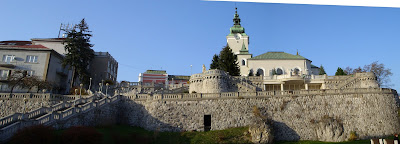 But actually his body isn't even there, because it disappeared sometime during the war. I'm totally interested in this part of Ružomberok-related history, because even after asking multiple people, I've yet to get a satisfactory answer. Hlinka's party became Tiso's party, and Tiso was (in my opinion, but not in the opinion of most Slovaks I've asked) a fascist, because of his collaboration with the Nazis during the war. The Slovak historiography seems to be that they were just doing what they could to make Slovakia independent (i.e. not Czech+Slovakia) but I don't see how a puppet state is independent at all... However, even though I think Tiso was pretty fascist, I also really think that Hlinka's popularity and memory was grossly misused after his death (cf. the Hlinka Guard) so maybe he (Hlinka) wasn't all that bad but Tiso was. But the really interesting part of all of this is that when I ask people about this period of history, the answer 90% of the time is, "We don't know, and we'll never know." An entire generation of people here were taught history at a time when it was being rewritten, and I think 20 years later things are still being sorted out.
Speaking of things still being sorted out after the fact, nearly 100 years after the independence of Slovakia from Hungary, there's still big-time, major anti-Hungarian sentiment here -- which the Hungarians tend to be highly mutual about. Last Sunday, the Slovaks and Hungarians played a (friendly) football match which turned deadly due to the presence of right-wing Hungarian football hooligans. After being subdued by the Slovak police, another crazy scary right-wing group started burning Slovak flags in front of the Slovak embassy in Bratislava -- they've been protesting since Sunday. I actually heard about this crazy scary right-wing group (Magyar Gárda) on Deutsche Welle's Inside Europe podcast -- and made the connection, which the TV news confirmed. The crazy scary thing about them is that their beginnings sound eerily similar to the Nazi party, right down to the disenfranchized, xenophobic, country-dwelling, young males. All of this makes me quite sad to see. When will we (humans) learn?
So yesterday on the news, in order for Slovakia to get back at Hungary for everything, they do a puff piece about the quality of Hungarian bread -- which is oft bought in Slovakia. It was unbelievable how un-newsworthy the subject was, especially because the people they found to talk about it tended to complement the quality of the bread anyway. And along the lines of further un-newsworthyness, last week there was a story of Czechs finding unexploded grenades around Dukla -- what can we expect? The stupid thing about it was that they take them and sell them at flea markets, and that is really stupid.
But not stupid is one Martinka Bobáňová from Terchová, also the birthplace of Jánošík. She's quite the little star of Slovensko Má Talent, and here are some supercute videos (especially the last one on the page -- it's chronologically the first and the best). She sings and plays the accordion and dances and I hope wins the entire thing. When they asked her what she'd do with 3million SKK (about $125,000), she said, "I've got lots of Barbie dolls, but they are homeless!" Supercute and totally worth a watch.
This morning at 6am, my mom woke me up with some great news. When I walked into the zborovňa, I got congratualations from all of my colleagues. By voting, we make the country we want to live in, we made a huge wonderful change and I believe we can do so much more together. I'm so excited to see how things work out, and I want to be part of it. Yes we can! -- I know people are saying Yes we did! which is true -- but as the Italians say, la lotta continua.
So alas, I started this post out all nice and then it rather turned into a beast. But that's how my mind kind of works.
On Monday, I went for a walk, as I normally do on Mondays after lunch, and I was so glad I brought along my camera -- because I was able to enjoy and then capture some amazingly beautiful details:
(click through to the website to see these pics if you're reading this via e-mail)
I love the palette -- I don't think I'd paint any living spaces in these colors, but I can most definitely live with them for the season. And while I'm at it, a shoutout to Leonardo da Pisa, detto Fibonacci -- for the enduringly amazing Fibonacci Sequence so often visible in nature (and elsewhere).But in the Western World, we are (subconsciously) into the idea of the Best General View -- so here's one:
 The hill is called Kalvária (see the Stations on the right), and the photo is looking towards the east -- so the mountains in the very background distance are the westernmost of the High Tatras. Right in the middle is the paper factory and the river Váh.
Finally, in the middle of everything back in town, there's the Hlinka Mausoleum (under the Slovak double cross):
 But actually his body isn't even there, because it disappeared sometime during the war. I'm totally interested in this part of Ružomberok-related history, because even after asking multiple people, I've yet to get a satisfactory answer. Hlinka's party became Tiso's party, and Tiso was (in my opinion, but not in the opinion of most Slovaks I've asked) a fascist, because of his collaboration with the Nazis during the war. The Slovak historiography seems to be that they were just doing what they could to make Slovakia independent (i.e. not Czech+Slovakia) but I don't see how a puppet state is independent at all... However, even though I think Tiso was pretty fascist, I also really think that Hlinka's popularity and memory was grossly misused after his death (cf. the Hlinka Guard) so maybe he (Hlinka) wasn't all that bad but Tiso was. But the really interesting part of all of this is that when I ask people about this period of history, the answer 90% of the time is, "We don't know, and we'll never know." An entire generation of people here were taught history at a time when it was being rewritten, and I think 20 years later things are still being sorted out.
Speaking of things still being sorted out after the fact, nearly 100 years after the independence of Slovakia from Hungary, there's still big-time, major anti-Hungarian sentiment here -- which the Hungarians tend to be highly mutual about. Last Sunday, the Slovaks and Hungarians played a (friendly) football match which turned deadly due to the presence of right-wing Hungarian football hooligans. After being subdued by the Slovak police, another crazy scary right-wing group started burning Slovak flags in front of the Slovak embassy in Bratislava -- they've been protesting since Sunday. I actually heard about this crazy scary right-wing group (Magyar Gárda) on Deutsche Welle's Inside Europe podcast -- and made the connection, which the TV news confirmed. The crazy scary thing about them is that their beginnings sound eerily similar to the Nazi party, right down to the disenfranchized, xenophobic, country-dwelling, young males. All of this makes me quite sad to see. When will we (humans) learn?
So yesterday on the news, in order for Slovakia to get back at Hungary for everything, they do a puff piece about the quality of Hungarian bread -- which is oft bought in Slovakia. It was unbelievable how un-newsworthy the subject was, especially because the people they found to talk about it tended to complement the quality of the bread anyway. And along the lines of further un-newsworthyness, last week there was a story of Czechs finding unexploded grenades around Dukla -- what can we expect? The stupid thing about it was that they take them and sell them at flea markets, and that is really stupid.
But not stupid is one Martinka Bobáňová from Terchová, also the birthplace of Jánošík. She's quite the little star of Slovensko Má Talent, and here are some supercute videos (especially the last one on the page -- it's chronologically the first and the best). She sings and plays the accordion and dances and I hope wins the entire thing. When they asked her what she'd do with 3million SKK (about $125,000), she said, "I've got lots of Barbie dolls, but they are homeless!" Supercute and totally worth a watch.
This morning at 6am, my mom woke me up with some great news. When I walked into the zborovňa, I got congratualations from all of my colleagues. By voting, we make the country we want to live in, we made a huge wonderful change and I believe we can do so much more together. I'm so excited to see how things work out, and I want to be part of it. Yes we can! -- I know people are saying Yes we did! which is true -- but as the Italians say, la lotta continua.
So alas, I started this post out all nice and then it rather turned into a beast. But that's how my mind kind of works.
02 November 2008
Sviatok Všetkých svätých
The way that these huge apartment blocks are constructed makes it possible to hear and smell everything that's going on around you. Yesterday, there was a lot of pork being cooked -- not just in my building, but in all of the buildings around me. In addition to the consumption of mass quantities of pork products, there were lots of license plates from the Czech Republic and beyond. Truly, one beautiful thing about how this feast is celebrated here is that it brings together living people. After visiting the cemetery, we visited with my relatives in Svidník -- they knew I was coming but had no clear idea when and so they were expecting me but I also kind of just showed up. And we had a nice visit.
 The Greek Catholic cemetery in Nižný Svidník.
The tombstone in the left foreground belongs to my great-great grandparents.
We got to Svidník around twilight -- and the cemetery was lit from the inside by the thousands of candles. Driving back to Prešov after dark, cemeteries usually invisible at night were glowing squares on distant hills. The night was so clear and so the candles on the ground were mirroring the stars above. We went to another cemetery and by that point in the day, there was also this strong but warm smell of wax -- and not cucumber pineapple cupcake blossom essence -- just wax.
 In the Soboš cemetery
 The Greek Catholic cemetery in Nižný Svidník.
The tombstone in the left foreground belongs to my great-great grandparents.
We got to Svidník around twilight -- and the cemetery was lit from the inside by the thousands of candles. Driving back to Prešov after dark, cemeteries usually invisible at night were glowing squares on distant hills. The night was so clear and so the candles on the ground were mirroring the stars above. We went to another cemetery and by that point in the day, there was also this strong but warm smell of wax -- and not cucumber pineapple cupcake blossom essence -- just wax.
 In the Soboš cemetery
I really love thinking about the idea that all of the people whose graves we visited had also done this for the people who came before them and so on -- and we hope people will do it for us. The continuity in this tradition is beautiful because it is how memory becomes eternal.
Better than I could explain it
Here are three short articles about English as a global language that really describe the direction I'm thinking towards. I've written about this before, but never felt I explained what I really meant.
- English Die Soon. "My American English, which I grew up speaking in an accent that matched what I heard on National Public Radio and 60 Minutes, is already difficult for many English speakers to understand." and "I like to play with language, and it’s hard to be quite so ludic when language is a tool and nothing more."
- Economies of Language. This exactly defines what I've been thinking about. Time to go rewatch some Firefly to brush up on Chinese skills...
- The Church of Please and Thank You. EFL teachers spreading the gospel of English + Anglophone culture -- oh wait, that's me.
Subscribe to:
Posts (Atom)