18 December 2011

Tapas in Andorra

I wanted to post this earlier in the week, but life gets in the way of life sometimes, doesn't it.

December 6 and December 8 are national holidays in Spain, and so since the 8th was a Thursday and I don't go to school Fridays, with some friends I decided to make a puente/pont out of it!  The goal was skiing in Andorra, but skiing didn't happen, unfortunately -- not for lack of wanting to, certainly, but due to other variables.

The good news is that I got to go to a lovely microstate, I learned the medical history of a Moroccan taxi driver and his bowel troubles that were cured by the geothermal waters, and then got to relax in said waters.  With my friends I also went on the world's longest alpine roller coaster and on an 8km downhill walk on a gorgeous day.  Most importantly though, we discovered Bar Turistic, which became a daily goal for the 3 days we were there.

When we arrived Wednesday 7 December around 11:30PM, after getting checked in to dour hotel and everything, we really needed to eat, because I was the only one who had brought something for the 3 hour bus ride from Barcelona (I had stuffed pizza a taglio from Pizza Gege, yes!).  However, food at midnight in Andorra is harder to come by than one would expect, since it seems people don't sleep much in this part of the world, and if they do, it's got to be Chuck Norris style or something -- haven't figured that out yet.  Anyway, after asking the locals for suggestions, we were heading to another place when we happened upon Bar Turistic.

Sometimes you find somewhere to eat that's just so good that you can't help yourself.  This ended up being that place for us on this trip.  Homemade, straightforward food that 4 people could eat + drink generously for under €10 a head.  And because it's Andorra, also breathe in secondhand smoke and watch locals play darts.

So a first night surprise, and I don't even remember how this came up, except that I think the proprietor just brought them to our table and immediately, it was a throwback to childhood -- madeleines of sorts -- lupini beans (Catalan: tramussos)!
Lupini beans, one of the tastes of my childhood

Saturday night, the 10th, was the football match to watch, the Clásico, Barça v. Madrid.  So of course, above the bar, there was a betting pool:
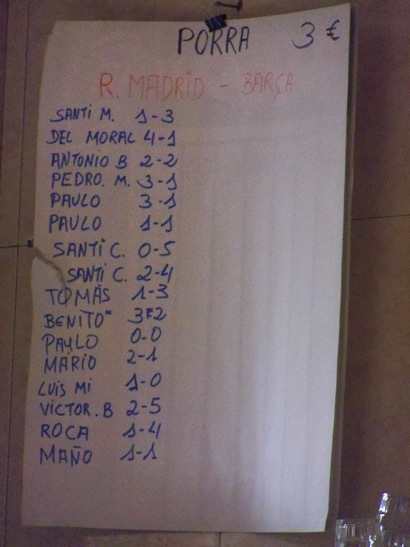
This chart grew over the next few days, but Santi M. and Tomas were already to be winners.
Visca Barça!

The next day was spent in the mountains of south west Andorra, and after an 8km walk downhill, not only were we feeling it in our hips, we were also feeling it in our stomachs.  While not eaten at Bar Turistic, this botifarra was magnificent: fresh sausage, white beans with some rosemary:
Botifarra at a locally-recommended place underneath the Andorran Ministry of Justice.

But that was just a snack, because there were already more things we wanted to try at Bar Turistic!  First off, the home made croquettes, a specialty of the house:
Chicken croquettes, also involving potatoes and maybe some cheese.  
Often at tapas places, or at bars where there are also tapas, there's a tabletop refrigerated case on top of the bar, and you can see some of what's available to eat.  So from this, we chose some pintxos of pork with some curry seasoning:
Pintxo is a Basque word meaning "spike" and this meat was prepared and cooked on a skewer.

Then something funny happened.  One of the food staples here in Mallorca is pa amb oli, bread with oil, but also involving tomatoes, called pan amb tomàquet in Catalunya.  First off, saying it in Mallorquìn was apparently kind of funny to the Andorran Catalan ear, and then, I made the comment, when it was suggested that we have some, that "we eat that all the time."  This was interpreted as, "give us your best shot," at which point the proprietor was like, "well, how about tongue" and of course, we could not decline.

Pork tongue!

This is now the second time in my life where tongue was presented as a challenge food.  The first time was over a decade ago in Poland, when our tour guide complained that we were being served too much sausage, and they were like, "hahaha we'll show you, here's some tongue in green aspic!"  I liked this dish, as the texture of the tongue was not completely offensive, and the sauce it was cooked in was delightful, along with some sauteed onions.  However, I would probably not order and eat a whole portion myself.

The next, and last night, we had more croquettes, because they really were quite good, and some of this cod salad -- I wasn't expecting it to be cold, or a salad -- but it was really very refreshing, perfectly acidic, and just the right amount of salty, the way good cod should be.


I'm not sure if all of this is particularly "typical" Andorran food -- most of the "Made in Andorra" food there seemed to be cow- and cheese-centered -- but this is typical tapas, and the elements that needed to be present for it to be successful were there: homemade and good company with whom to share it.

07 November 2011

Coming attraction:

Català, mallorquín, castellano: the politics of communication

Els castellers de Mallorca

[This took place on 15 October - I had problems uploading the video, so I'm finally posting now.]

Already four years ago, in Tarragona, we saw this incredible sculpture of the castellers, and at the time I never thought I'd see the castellers in real life.  As it turns out, the castells were declared as having UNESCO Intangible World Heritage protection status in 2010.

I got to the Plaça de Cort really early, which was good because I got a primo spot on some built-in benches of the Palma city hall, perfect for watching everything.  The building itself is really rather interesting, because of the aforementioned built-in benches and an exaggeratedly large cornice, making it clear in 16-18th century architectural vernacular that it is a publicly-minded building. 

The first to arrive, besides an old lady and me, was the ambulance crew.

Soon enough, people started to arrive wearing similarly-colored shirts, and then all of a sudden I started to hear shouting, chanting, then nasally-sounding instruments, and then gigants in motion!  The castellers were coming down the street, en masse!  The home team, Els Castellers de Mallorca, made a small castell, a pilar, and sent a kid up to the balcony of the city hall, the other two teams, els Al·lots de Llevant, and els Margeners de Guissona, also made pilars, and then the fun began with the castells.


In the video, you'll see the gigants leading the parade of castellers down the street.  Gigants are huge puppets used during festive occasions all over the island, and each town seems to keep theirs on view in the city hall when not in use.  The smaller demon gigant is especially used on Mallorca during the feast of Saint Anthony the Abbot on 17 January.

As they were parading up the streets, the castellers were also putting on their long black sashes, called faixa, which are like cumberbunds supporting their lower backs (important) and are also used as like stairs or footholds when people are climbing up the castell.

At the base of the castell is the pinya, the mass of people at the base.  At the center, they are holding hands in a circle, and then each person behind them supports the arms of the person in front of them, and so on and so on:
The pinya forming

I liked seeing this because I thought it was a lovely metaphor for the kind of world I want to live in, starting from the point that everyone is supporting each other, and people from the different teams join in to support the team who is actually making the tower.  Everyone's prepared to get stepped on a little, and the tower might collapse, but they're all there to stay supportive to the end -- and the metaphor can keep going on and on and on.  Maybe the video will inspire some continuations and/or variations of the metaphor.

In the meantime, there are instruments being played: a drum, and some grallas, which are double-reed instruments making the nasal-sounding accompanying music, called the toc - there are different songs for coming in, and the start of the music announces the start of the castell and seems to help create rhythm for the feat.

Playing the gralla

The each of the three teams took turns making a castell, and then finally the home team made one last attempt:


This is really worth watching, because [spoiler alert] the tower collapses towards the end of the video.  In real life, as on the video, it happened in slow motion, like it was expected but maybe it also would've been fine.  What's also awesome is the end of the end - it's all still a celebration of success and above all, teamwork!

The next Wednesday, I was in the teacher's room at one of the schools where I teach, and I realized that one of my colleagues is a casteller.  I was asking him about it, like why he did it (do you wake up one morning and decide you want to be a casteller?) and in addition to learning that the younger people in the middle sections of the tower are usually the ones who were at the top when they were smaller, meaning that everyone has years of practice doing this (they practice weekly) and there is a coordinating person. It's partly a cultural expression, and partly just a group of friends who hang out doing this every week.  When I commented on the collapse, he said, "oh, people don't usually get hurt just a few bruises maybe.  It's safer than playing football." I replied, "that's like saying it's safer to fly in a plane than it is to ride in a car." His response? "well, it is."  But how many people can say that their hobby has UNESCO World Heritage status?

02 November 2011

November is a month for writing!

Writer types of people are perhaps already familiar with November as NaNoWriMo, and of course it's Movember, but it's also the 30 Days of Independent Travel Project!  Hopefully it will help me to articulate some of the thoughts and feelings I've been having lately about travel.

The first prompt was about goals, and really, right now, I don't have any huge travel goals.  What I'd like to make some comments on is ch-ch-ch-change.

In the last year, I've become a lot less resistant to the idea of using a backpack as a way of carrying things while I travel.  This is directly attributable to the Hadrian's Wall Path trip, out of efficiency and necessity.  During my formative years in Rome, I would see people with outrageously huge packs wearing flipflops (can't be good for your feet) arguing in front of the ticket windows in Termini, and it just didn't seem like the kind of traveler I wanted to be.  So for years, I tried to project a more business-like, jet setter look with a black carry-on roller suitcase, which can be fine for intercity travel but is obviously impractical for tromping through sheep fields in Northern England.  When you stop and think about it, it's also impractical for the incredibly unevenness of urban streets, as well. 

Most of my distaste for backpacks comes from trips staying in youth hostels and sleeping in the back of a Volkswagen Eurovan with my parents in the early 1990s.  My reactionary travel style developed into a sort of middle ground, trying to seem as normal and cultured as possible while still keeping the budget low.  This usually ends up meaning means private rooms with shared bathrooms as accommodations and using a carry-on wheelie suitcase, and doesn't go much further.  Lately, I've also been thinking about how much the internet has changed the way we travel - comparison-shopping for flights and hotels, and I'm addicted to TripAdvisor reviews to give myself the sort of experience I want and expect to have.

A bit sunburnt, too!
Though the Hadrian's Wall Path trip caused me to go and buy a backpack, spending so much time on trains in Slovakia is what softened me to the idea.  Students traveling to and from Bratislava on weekends use big backpacks like I'd see in Roma Termini, and they clearly were also not backpackers.  Yet, as I plan and do more and more independent travel, and I think back on various journeys, really, deep down, I'm more of a backpacker than I'm often willing to admit -- and I couldn't do what I do otherwise.  I've picked up skills, habits and tolerances (making choices as an adult, not as a 4 year old, though that certainly helped!) doing this style of travel in Europe that have been making me dream of Megabusing it all over America (really? yes.) and I think I can accept the greater self-awareness and especially self-acceptance: 
Hello, my name is Maria, and I am a backpacker.

01 November 2011

Table Wine Marketing and Customer Loyalty

Last week, I walked into the school office because I had some paperwork to complete, and the two guys in the office were discussing their sandwich choices for the mid-morning snack.  I think it was only about 9am.  After my first class, I had two hours break, so I went to the cafe down the street for a much-needed coffee.

The cafe was busy, it's a nice local place and I've gone there often enough that the waiter has begun to recognize me.  Apparently they also serve the best frito mallorquin in the port, which I've yet to sample, but I can vouch for their coffee and sandwiches.  Anyway, in a busy cafe, and not just this one, I'd noticed that there are half-full bottles everywhere, and then in the afternoon they live on a sideboard in the restaurant.  Same thing at the cafe on the other side of the port where I often go with colleagues from the other school where I teach. 

When I got back to school, I asked the guys in the office about this - because all over the cafe, there were open bottles of wine, and in a few cases, liquor, on the tables.  I've never seen anything like it, and how do they figure out how to pay?  As it turns out, this is a local custom that is meant to help build customer loyalty.  See, the bottle of wine, because it's just table wine (though obviously drinkable), costs maybe 2 or 3 Euro.  If they charge a Euro a glass, they'll make the cost of the bottle back fine, and it all evens out (though that attitude on a large scale may be what's causing the economic situation we're finding ourselves in here in the Mediterranean states).  The same goes for people who like to put a bit of liquor in their coffee; people like to put their own in because it makes them feel like they're trusted customers, and it all evens out and the cafe still makes a profit.


The guys in the school office compared it to the bottomless cup of coffee in American restaurants, with the interjection, "but how could you drink that stuff anyway? One cup of that and I'd be straight to the bathroom!"  Here in Mallorca, it's just snack time, a glass of table wine, and 'marketing'.

folding bicycles, an infatuation story


Here's my sweet little vintage folding bike, which I love and already know I will have trouble parting with.  It's a now-defunct Basque brand, GAC (Garate, Anitua y Cia).  When I took it into a workshop because the front tube needed replaced, the guy pointed at all of the other bikes he had available as rentals, and commented on how this one's like new and he has to replace the rentals annually.

I might add that the photo doesn't do it justice because it doesn't show the chain guard and glorious crank case as well as it could.  Doing some internet-based reconnaissance, I realize I acquired it for a steal, considering its condition, and if I was serious at all, I probably wouldn't be using it for daily use -- but then what fun would it be?  It has front and back lights which work with a little motor that engages onto the front wheel, carries my groceries well and it's becoming recognizable around town.

It reminds me of this Eska I spotted this summer in Nová Sedlica:

Because really, for all that we speak of mid-century modern design, which can be all sexy and jet-setty and Corbusian and all kinds of adjectives I love, this is it.  These bicycles are the epitome of European mid-century modern, because they embody the post-war European working class -- we've moved on from Ladri di biciclette, now this is something everyone can have and afford, and in a sense the only thing that makes these bicycles special now is that they still exist.  What I also like is that while these bikes are on the surface opposites: fascist/communist, Basque/Zemplín, red/blue, etc they're essentially the same folding bike (though the GAC has some lovely bourgeois curves) to be sold to the same people at the same time, just in different places. 

My soft spot for this style of bicycles comes from a delightful ride along the Barceloneta back in 2007 -- back home, I've got a steel Chinese-made model from my university years, and I'm looking forward to even more delightful rides with this one.

Cap de Formentor and Talaia d'Albercutx

The day we went to Cap de Formentor, it was overcast, wanting to rain, creating the drama of the Mediterranean in the autumn and winter.  This is one of the most famous areas of the island, and it certainly didn't disappoint.

This picture was taken from ~300m above sea level.
Farther up the windy road (built by an Italian) from the Mirador de Mal Pas is the Talaia d'Albercutx, which I can see from my window.  I've seen it described elsewhere by an English person as a "pepper pot" but this short article is really worth a read for the history of watch towers on Mallorca.

On the way up to the watchtower, there's ruins of an abandoned project of some kind, with the accompanying street art.  This one declares that we're on liberated land.
Going up to the top of the watch tower requires climbing a wire rung ladder to a middle level and then up another and some scrambling through a hole in the floor to get to the top level.  It's the sort of unregulated, slightly unsafe historic European thing that would never happen in the US for fear of lawsuits, which is of course what makes it so fun and also slightly terrifying.

And at the top of the tower, proof of Roma caput mundi.
The highlight were the wild goats everywhere, of whom sadly I was unable to catch a good photograph.

Tots Sants

Today is one of my favorite holidays (see here), perhaps because of how understatedly visceral it is.  Further, cemeteries are one of the most interesting places to visit in a new place -- they say so much about the customs and traditions of the locals, which is especially meaningful here, where sometimes the locals are hard to spot.  You can tell how special a day it is when even Lidl, which is open Sundays, is closed for the holiday today.

Little Spanish ladies dressed in black, in the way that you know they're in mourning clothes because it's not quite a chic look.  Others dressed in work clothes carrying buckets and brooms into the cemetery so that they can clear off the tombstones to get them ready for the new flowers.


I didn't expect the cemetery to be so paved.  There was no space in the cemetery for anything to be planted, everything is covered in stone.  There were some beautiful statues and even more beautiful typography on the stones.


The fall flowers were beautiful, lots of mums but also lots of gladiolas.  It makes me remember the defiantly red gladiolas on Antonio Gramsci's grave last time I was in the Protestant Foreigner's Cemetery in Rome, quite possibly my favorite cemetery I've yet been to.  Here, what was missing was the candles - which truly do add more visceral layers to the experience - but we had the sun, so no complaints.

This feast makes me wonder why we don't really celebrate it this way so much in America - quite possibly the commercialism of Halloween does truly eclipse it, and it's really too bad, because this is what it's about.

17 October 2011

El pueblo unido jamás será vencido

"The people, united, will never be defeated."

[I wrote this right after the 15O protests, and am publishing it on 7 Nov 2011.  The last few weeks, with continued politics in Europe deriving from and influencing the credit crisis, and notable events in Oakland, CA, only confirm to myself what I've written and thought about this already.]

For the last few days, I've been thinking about how to discuss Saturday night in such a way so as to share what I did and why, and also to respect the possibly divergent views some of my loyal readers might have.  Then today, the NYT Architecture critic Michael Kimmelman gave me the answer:
It's something I've internalized for the last 10 or so years of my life, and the idea of "the European social compact" is something I've been thinking about intensely for the last few months (because a lot of my life is balancing between European and American social contracts) without knowing exactly how to verbalize it. 

I remember when we first moved to Rome, 11 years ago - back then people were angry about most of the same things, but it was a more anti-corporate vibe, whereas now it's a much more anti-banks, anti-financial institutions vibe, and one that seems to me to be more accurately placed.  Simply speaking, if I want a cell phone or computer or most other consumer goods without making things really difficult for myself, I've got to get them from some huge multinational corporation, so choices have to be made and usually the market supports that.  On the other hand, the sort of actions banks and other financial institutions have been making over the last 30+ (100+, 500+) years has helped us get to that point while they have stolen money from just about everyone possible - us, and the governments they bought that are supposed to also represent us.

Anyway, I remember when I saw my first march of ~20,000 communists walking down Via Barberini (strange place for a march, I know, but that's where they were that day) and I almost peed my pants, I was so scared because I thought, "Oh no! The communists! And there's so many of them!"  Meanwhile, other people around paid no attention and went about with their business - and in the last 11 years, communists have not taken over Italy or anywhere else, really - not a threat, and yet the fight continues.  Then September 11 happened and I remember standing in Piazza del Popolo around significantly fewer members of Italy's right wing parties in solidarity with the USA (a strange experience, mostly because of the creepster neo-Fascists present), and a few years after that, I demonstrated for peace in Oakland (before Schenley Plaza was built and gained notoriety during the G20) and Central Park, and then the great Rally to Restore Sanity on the Mall in DC, and Kimmelman's point is proved.  These spaces are integral to our public conversation.

Yesterday, in Palma, I had a cortado (read: espresso macchiato) while sitting on a bench the Passeig de Born.  A few hours later, it would be filled with 20,000+ people who were united for #globalchange, and then, just a few hours after that, back to normal again.  Nothing got broken, no one got harrassed - back to that old European social contract.  

The other important part of the social contract is an inherent respect for others -- the communists present did not beat up on the socialists over the differences they may have on the distribution of wealth.  Folks recognize what they have in common, and get together to help make a step in the direction of the world they want to live in, myself included.  These demonstrations are not monoliths, they're many different groups of people who get together to help each other make their voices even louder.


The atmosphere was pretty much a party, because of the Drums for Peace, which also set a rhythm for the march, there were songs and dancing and it was a warm, autumnal Saturday evening so we were all out for a nice walk!  But do not misunderstand a party-like atmosphere for this being taken lightly - except there's so much to celebrate: our humanity, being alive, being together, and our shared convictions.  Spain has gotten plenty of practice lately in this sort of thing, because of and from the 15M movement -- and in a lot of ways, this was an extension of that, because the problems have still yet to receive an adequate solution and so truth must continue to be spoken to power.  This demonstration had it all - the communists, socialists, anarcho-syndicalists, grandmothers, kids in strollers, middle-aged folks blowing whistles and some awesome Adbusters-inspired street theatre weaving through the crowds.  As public buses passed, drivers honked in solidarity, causing us all to make sure the driver could hear our thanks.  Now might also be a good time to add that there were posters for this demonstration at both of the schools where I teach, and I actually ran into a colleague there!  So, this is not a movement of a bunch of hippies - it's people who look like you and me, who work for an honest living, and who actively participate in the democratic process.

There were some great slogans and chants, again, many carried over from 15M, and responding to the huge amounts of money that is being siphoned away from taxpayers everywhere, as we're coming to find out.  For example: "No hay pan por tanto chorizo [there's not bread for so much chorizo, meaning thievery in addition to sausage]" and "Manos arriba, esta es un atraco [hands up, this is a robbery]!" And another: "Si no nos dejan soñar, no os dejaremos dormir [If you won't let us dream, we won't let you sleep]".  And another: "Protesta como un ciudidano o calla como un servo [Protest like a citizen or shut up like a servant]".


The police were pretty unobtrusive and mostly were there to serve as traffic cops, but as we were walking from Plaça Rei Joan Carle I up the Avinguda Jaume I, I realized real fast what a terrorizing tactic kettling could be.  I think my American experiences (seeing mounted police, riot police, plain clothes police - thankfully only using intimidation tactics when I've been present) made me way edgier than 99% of the people there, and I was jealous of that -- how wonderful that so many families were there with small children, so many older people walking with canes, and so obviously unworried about any potential violence -- there's our social contract again, that the police are there to protect the demonstrators, not others from the demonstrators.

"I too am indignant, like my mom and my dad."


Towards the end of the march, we, following one of the themes of the march to "toma el calle [take the streets]" we sat down on the pavement in the street for a while, then got up and ended with a rally of sorts in Plaça Espanya, where I got to see the street theatre up close:
Adbusters-inspired street theatre, with actors representing various negative aspects of capitalism (military spending, education cuts, etc) being pushed in shopping carts by zombie televisions

After getting some real, cut-with-scissors-and-weighed-by-an-Italian pizza a taglio, I was able to catch the end of the ball de bot across the street in the Parc de ses estacions.  There, the castellers were grilling meats on public grills, with public tongs chained to said grills.  A European socialist paradise, indeed!

16 October 2011

The Price of Water

I'm hard at work preparing two posts about Saturday, which will be finished as soon as my videos upload to YouTube.  In the meantime, a quick thought about price fluctuations and/or comparison shopping in real life, because I've never been anywhere where the differences were so obvious.

Here, it's recommended to use bottled water for drinking and cooking, because there is so much calcium in the tap water -- it's nothing bad, in fact it could be quite good, and I use the bottled water mostly for coffee.  One jug lasts me a week.

But since I live in tourist central, buying something as simple as 6L of water is a classic situation of supply, demand and convenience.  Between my house and work, there's a Lidl - a European discount grocery store very similar to Aldi - where I buy most of my groceries.  However, it's a bike ride away and I try to maximize what I can carry with me in my backpack and on the bike rack - water would take up too much space and weight.  In the basement of my building, there's a Spar - basically, a convenience store, and about a block down the street, a larger, independently-owned-but-catering-to British-tourists small grocery store.  Up and down my street, there are about 5 or 6 Spars.


All three of these waters are bottled from two places here in Mallorca. 
On the left, purchased at the Spar in my building, 5L of water for €1.98.
In the middle, purchased down the street, 6L of water for €0.99.
On the right, purchased farther down the street on the main road, 1.5L of water for €1.50 - same water as the one on the left.

Sometimes, the stuff at the place down the street is less, or the same price as Lidl.  I buy my coffee and a few other things in Palma because I've had to be there for something else and it was convenient and less expensive to grocery shop there than ride my bike farther to other normal-priced grocery stores nearby. 


This isn't about bottled water being fancy, nor is it about how easy it could be to rip off tourists - it's mostly about how sometimes, bulk is cheaper and there are questions of convenience involved.  The same goes for the type of cream I use in my coffee, the baguettes I buy for bread, and the ready-made gazpacho that's so refreshing and healthy; it's just been a long time since I can remember being somewhere where the differences in price were so considerably obvious.