Last weekend, we got some Amish beets down around Salisbury, PA. I should've gotten more, because I love beets. I could get them at the grocery store, obviously, but these beets are all natural and locally grown, for sure.
Anyway, what better to do with beets (besides eat them plain roasted with just salt or some goat cheese?) than make some borscht? This is how I make it:
(Click here if you're reading this in an e-mail and can't see the video.)
10 August 2012

09 August 2012
How to make tombet
Based on what I hear from loyal readers IRL, my food posts are popular (shoutout to the Uniontown crew!). So instead of posting all of the other things I eventually want to write and share, I made a video of how to make one of my favorite Mallorcan dishes: tombet. This dish is everything that makes Mallorcan food so great - it's rustic and very tasty. There are only a few ingredients: flour, olive oil, tomato puree, potatoes, red pepper, eggplant and zucchini (zucchini is apparently more of a post-modern addition, but if you've got it in the garden, you can only make so much zucchini bread, right?).
It's kind of a lot of prep work, but that can be eased with a mandoline slicer and a helper, and the effort will reward your taste buds infinitely.
(Click here if you're reading this in an e-mail and can't see the video.)
The music accompanying the video is by a contemporary Mallorcan folk group, Caliu.
It's kind of a lot of prep work, but that can be eased with a mandoline slicer and a helper, and the effort will reward your taste buds infinitely.
(Click here if you're reading this in an e-mail and can't see the video.)
The music accompanying the video is by a contemporary Mallorcan folk group, Caliu.
01 May 2012
Language is Identity and Domination
A friend asked me for an English version of this blog post - so I translated it, and I'm just putting it here so it has a place to live on the Internet - though I might add that I find it to be a good, succinct description as I work through some of these thoughts myself. Credit goes to the author, Jean-Marie Rossi, and the original article can be found here - the emphasis is from the original.
Language is Identity and Domination
There is,
perhaps, a lesson in particular that we really do not want to learn from
post-modernism. And that lesson, first sociological and then anthropological,
was the firm realization that any tool - physical and otherwise - carried
within itself the spirit and culture of those who had developed it. It is not a
question of renewed spirituality, some kind of New Age mysticism and, even less,
being read in an introduction to the historical and religious imagery in
Tolkien.
Language, as we all know, is obviously a tool. But it is not just a tool. And at every level, from the first words spoken by Homo sapiens to the most beautiful pages of Melville’s Moby Dick, it imposes rule on chaos. And the rules define what is right from what is not: in this, language is the first scheme of manners that we encounter as children. It is, broadly speaking, what is closest to a matrix, and matrices define a particular way of seeing things.
Any language has a dual character: it is a means of communication and a carrier of culture. English, for example, is spoken in Great Britain, but is also used in many other countries, like Sweden. But for the Swedes it is just a means of communication with those who do not speak Swedish. It is not, at first glance, the generic carrier of English culture. For the British, of course, their language is both a means of communication and the fundamental carrier of their culture.
By “carrier of culture” we mean that every word corresponds inescapably to definite cultural and symbolic baggage is inscribed in the collective memory and imagination of those who share the same language. The word “republic” for an Italian or a Frenchman has the same meaning, but lights up different collective memories and expectations in each of them.
That having been said, it remains only to give an example. One hundred and twenty years ago the European capitalist states sat down in Berlin with a machete and cut an entire continent - Africa - with the greatest multiplicity of the world's peoples, cultures and languages, into different colonies. The draft partition of Africa made in Berlin was economic and political, but it was essentially cultural.
The Congress wanted by Bismarck, to prevent a massacre of Europeans in Europe, divided Africa into several states and, therefore, in different languages; and these languages were European. Since then, the African states define themselves based on languages imposed upon them by their colonizers: Anglophone African countries, Francophone African countries and African countries of the Portuguese language.
It was like the detonation of a bomb, a cultural bomb. And the cultural effects of this bomb were those of annihilating people's faith in their names, their languages, their relationship with their natural environment in their communities, in their abilities, and finally, in themselves. So language, and its enforcement, became a weapon. Because the control of a language and its use has the power to control one of the main tools of self-definition of people in relation to their natural and social environment and, of course, in connection with the entire universe.
The decisions made in Berlin in 1884 were imposed on African people with the use of force. But violence is not enough to subdue an entire community. Economic and political control can not be considered truly complete or effective without mental control. And to control the culture of a people it is necessary to check the instrument with which it is defined in comparison with other nations: its language.
It is how Ngugi Wa Thiong'o writes in his essay Decolonizing the Mind: “The night of the sword and the bullet was followed by the morning of the clack and the blackboard.” So in late nineteenth century Africa, if violence was the means of physical subjugation, language was the means of spiritual subjugation. So the Africans slowly began to dream of the West, to want to live like Westerners, want to be Western.
For the imperialism of the time, like that of today, the psychological control of the colonized is a nodal appearance for the maintenance of power. It goes without saying that the imposition of their language allows both the progressive destruction of the culture of the colonized people through the undervaluation of its arts, its religions, its history, its manners and it is the conscious elevation of the language of the colonizer. And all this in one step.
One example of today's Hollywood. We've all dreamed of living the American Dream and this is cultural control, of language and dreams. In it, the Yankees won against the Soviet Union, because, after all, the ballistic missiles would not be enough. And China today in its rise to world leader is still lacking on this point. No one dreams of becoming Chinese, and this will not change for a very long time.
A hundred and twenty-eight years later after the psychological education strategies implemented in the context of the “Scramble for Africa” we have not yet fully understood the value of our languages in the preservation of our independence as individuals and as collectives. Yet in an era where chaos reigns, but where war – among peers - is no longer allowed to dominate the Other all that is left is culture war. In the final analysis, it is the most devious.
Language, as we all know, is obviously a tool. But it is not just a tool. And at every level, from the first words spoken by Homo sapiens to the most beautiful pages of Melville’s Moby Dick, it imposes rule on chaos. And the rules define what is right from what is not: in this, language is the first scheme of manners that we encounter as children. It is, broadly speaking, what is closest to a matrix, and matrices define a particular way of seeing things.
Any language has a dual character: it is a means of communication and a carrier of culture. English, for example, is spoken in Great Britain, but is also used in many other countries, like Sweden. But for the Swedes it is just a means of communication with those who do not speak Swedish. It is not, at first glance, the generic carrier of English culture. For the British, of course, their language is both a means of communication and the fundamental carrier of their culture.
By “carrier of culture” we mean that every word corresponds inescapably to definite cultural and symbolic baggage is inscribed in the collective memory and imagination of those who share the same language. The word “republic” for an Italian or a Frenchman has the same meaning, but lights up different collective memories and expectations in each of them.
That having been said, it remains only to give an example. One hundred and twenty years ago the European capitalist states sat down in Berlin with a machete and cut an entire continent - Africa - with the greatest multiplicity of the world's peoples, cultures and languages, into different colonies. The draft partition of Africa made in Berlin was economic and political, but it was essentially cultural.
The Congress wanted by Bismarck, to prevent a massacre of Europeans in Europe, divided Africa into several states and, therefore, in different languages; and these languages were European. Since then, the African states define themselves based on languages imposed upon them by their colonizers: Anglophone African countries, Francophone African countries and African countries of the Portuguese language.
It was like the detonation of a bomb, a cultural bomb. And the cultural effects of this bomb were those of annihilating people's faith in their names, their languages, their relationship with their natural environment in their communities, in their abilities, and finally, in themselves. So language, and its enforcement, became a weapon. Because the control of a language and its use has the power to control one of the main tools of self-definition of people in relation to their natural and social environment and, of course, in connection with the entire universe.
The decisions made in Berlin in 1884 were imposed on African people with the use of force. But violence is not enough to subdue an entire community. Economic and political control can not be considered truly complete or effective without mental control. And to control the culture of a people it is necessary to check the instrument with which it is defined in comparison with other nations: its language.
It is how Ngugi Wa Thiong'o writes in his essay Decolonizing the Mind: “The night of the sword and the bullet was followed by the morning of the clack and the blackboard.” So in late nineteenth century Africa, if violence was the means of physical subjugation, language was the means of spiritual subjugation. So the Africans slowly began to dream of the West, to want to live like Westerners, want to be Western.
For the imperialism of the time, like that of today, the psychological control of the colonized is a nodal appearance for the maintenance of power. It goes without saying that the imposition of their language allows both the progressive destruction of the culture of the colonized people through the undervaluation of its arts, its religions, its history, its manners and it is the conscious elevation of the language of the colonizer. And all this in one step.
One example of today's Hollywood. We've all dreamed of living the American Dream and this is cultural control, of language and dreams. In it, the Yankees won against the Soviet Union, because, after all, the ballistic missiles would not be enough. And China today in its rise to world leader is still lacking on this point. No one dreams of becoming Chinese, and this will not change for a very long time.
A hundred and twenty-eight years later after the psychological education strategies implemented in the context of the “Scramble for Africa” we have not yet fully understood the value of our languages in the preservation of our independence as individuals and as collectives. Yet in an era where chaos reigns, but where war – among peers - is no longer allowed to dominate the Other all that is left is culture war. In the final analysis, it is the most devious.
22 January 2012
Sunday at Alcanada
So there are a few hikes near Alcúdia that my friend Laura and I have been trying to do, but the days are still just a bit too short for the amount of time they'll take. So instead of a longer walk, we went to a part of Alcúdia called Alcanada, found a spot and had a bit of a picnic.
The part where we were wasn't particularly beachy, though in warmer weather it wouldn't be a bad place to swim, off of rocks.
The weather was beyond gorgeous, the weather forecast said a high of 61°F but it had to be warmer, and I definitely got a bit of sun, though some parts of me are so pasty that I think I reflect the light more than I absorb it.
Alas, here are three views from where we were sitting:


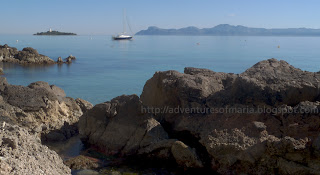
Regrets about the watermarks; if you want to use my photos elsewhere, please feel free to contact me and we can work something out.
The part where we were wasn't particularly beachy, though in warmer weather it wouldn't be a bad place to swim, off of rocks.
The weather was beyond gorgeous, the weather forecast said a high of 61°F but it had to be warmer, and I definitely got a bit of sun, though some parts of me are so pasty that I think I reflect the light more than I absorb it.
Alas, here are three views from where we were sitting:


Regrets about the watermarks; if you want to use my photos elsewhere, please feel free to contact me and we can work something out.
05 January 2012

04 January 2012
Christmas Break part 3: Vienna
Ahhh Vienna. To be in the former bosom of my ancestral imperial overlords is always a good feeling -- it's a place where I don't seem to need a map, I just can be and get where I need to go, wherever that might be. During the holidays, it's a beautiful place to be, with all of the lights and people out enjoying it and everything.
In general, January is quite possibly the best time of year to buy clothing in Europe. To be in a city like Vienna during such sales borders on dangerous, and would have been if I was in a more reckless mood. I did get a few new pieces for my wardrobe, though. And I hit up one of my favorite casual restaurant chains (for a chain concept restaurant, very pleasant), Vapiano.
But since my mother thinks I never go into churches, here's some proof:
Other than that, the only other thing I have to share from this quick stop in Vienna is this:
 Grandma would've had a great time working with them!
In general, January is quite possibly the best time of year to buy clothing in Europe. To be in a city like Vienna during such sales borders on dangerous, and would have been if I was in a more reckless mood. I did get a few new pieces for my wardrobe, though. And I hit up one of my favorite casual restaurant chains (for a chain concept restaurant, very pleasant), Vapiano.
But since my mother thinks I never go into churches, here's some proof:
 |
| The Rusyn Greek Catholic icon of Our Lady of Máriapócs, looted by Emperor Leopold I at the beginning of the 18th century |
 |
| Rockstar Christmas decorations in Stephansdom, totally wonderful |
Other than that, the only other thing I have to share from this quick stop in Vienna is this:

Christmas Break part 2: Slovakia
Getting from Barcelona to Prešov was about a 16-hour affair, including a significant wait in Bratislava Hlavná Stanica, which is a not very nice place. However, there is free wifi and a cart selling rezeň sandwiches, so it's a bit better than I remember it and it's now tolerable.
You can't buy train tickets with seat reservations from abroad, and anyway, by the time I got to Wien Südbanhof Ost, the ÖBB office there was already closed. I knew I'd have plenty of time to buy tickets in Bratislava anyway. Buying a sleeping space on a train that left at 11:45PM was a good idea.
When I got to my spot, the conductor for the car took my ticket and asked if I wanted coffee or tea in the morning. Knowing that coffee would either mean Slovak-style Turkish coffee or instant, I opted for tea, which was a good choice. The train went straight to Prešov, meaning no switch in purgatorial Kysak. Before the train left the station, there was some socializing happening on the train between the compartments -- the other lady in my compartment and the guy next door were chatting, and I was brought into the conversation. She asked me where I was going (Prešov), was I studying there (no) and so then where was I from? I asked her if she couldn't notice my accent, and she couldn't (East Slovak and an American accent are not always so far removed from each other) and it turns out, she actually couldn't tell, because she was a Hungarian Slovak! So after I spread the Rusyn Gospel, we briefly discussed minorities in Slovakia and went to sleep. Except sleeping on a train is a bit ridiculous, even on the smooth Slovak rails, with lovely crispy starched sheets and duvet covers.
I'm going to guess that the current cars are the former first class cars -- because really, I don't remember it being this nice on our (or rather my dad's) (literally) ill-fated trip from Humenné to Vienna in July 1992. The compartment was Slovak standard eat-off-the-floor-clean, with water, towels, wafer crackers and the aforementioned tea. So civilized, especially for something I generally try to avoid doing (taking overnight train rides).
The rest of the week I was in Slovakia, I think I took maybe 3 other pictures, which were not very interesting. My visit was not purely social, but I had a blast at the molody.Rusyny zabava, and other than that got a lot of concrete things accomplished and am looking forward to getting back in the summer. When I visit with people there now, there are no long prolonged goodbyes anymore, it's just expected by all parties involved I'll be back soon -- and I will. The biggest compliment I can get there (because really, being mistaken for a local by a Hungarian is mostly funny in the context) is, "Maria, už sy naša (basically, Maria, you're one of us)" and it makes me feel so good, because it's how I feel there too.
After a too-quick stop to see my Ružomberok crew, I left for Vienna.
You can't buy train tickets with seat reservations from abroad, and anyway, by the time I got to Wien Südbanhof Ost, the ÖBB office there was already closed. I knew I'd have plenty of time to buy tickets in Bratislava anyway. Buying a sleeping space on a train that left at 11:45PM was a good idea.
 |
| In my bed on the train |
 |
| As much of the compartment as I could fit into one frame |
The rest of the week I was in Slovakia, I think I took maybe 3 other pictures, which were not very interesting. My visit was not purely social, but I had a blast at the molody.Rusyny zabava, and other than that got a lot of concrete things accomplished and am looking forward to getting back in the summer. When I visit with people there now, there are no long prolonged goodbyes anymore, it's just expected by all parties involved I'll be back soon -- and I will. The biggest compliment I can get there (because really, being mistaken for a local by a Hungarian is mostly funny in the context) is, "Maria, už sy naša (basically, Maria, you're one of us)" and it makes me feel so good, because it's how I feel there too.
After a too-quick stop to see my Ružomberok crew, I left for Vienna.
Christmas Break part 1: Barcelona
I know I've been horrible about updating lately. I want to, but I also want to keep this blog at a certain level and my standards are often too high for myself, unfortunately.
 On Christmas Eve, I flew to Barcelona, and enjoyed walking around the city center. People were still out walking and hanging out on Las Ramblas until late, so it wasn't too bad. However, Christmas Eve dinner was a rather sad affair, at a tapas bar, and consisting of crab croquettes, bacalao croquettes, some quite nice roasted pork with vegetables, and a beer. Sitting by myself at the bar. It made me a bit crabby and teary, but I also realize in retrospect I was having some PMS and that is what made me more teary -- the being alone part made me more sad and angry. Angry, I don't know why, and not sad for myself but because I know there are tons of people who also don't have anyone to spend holidays with and that's horrible.
Christmas morning, I got up really early to get the first train to Montserrat. I was so excited to go back there -- my first visit there was so special, and this time I knew exactly how to get there. While waiting for the Aeri, I was in line behind an Italian family, and the little girl said something to me in Italian, and I responded normally in Italian. She asked me what region I was from, and I said, "L'America" and the look on her face was precious. She reminded me of the sweet little girls I met and talked to once in Calabria -- they were the ones who asked me if there were crocodiles in the NYC subway (no, just huge rats at Canal Street station).
My first priority when I got there was to get some coffee, and then by that time it was time for mass at 11am. The famous boys choir sang, and everything was completely in beautiful Catalan. I can get on board with the clash of nationalist fervor and Catholicism when it's a nationalist fervor I'm sympathetic to -- souvenir in the gift shop had the Virgin of Montserrat with the following text: La meva terra, Catalunya - La meva parla, el català - La meva dansa, la sardana - El meu desig, la llibertat (My land, Catalunya - My language, Catalan - My dance, the sardana - My desire, freedom).
The last Aeri (and train, for that matter) down the mountain was at 2PM, so I left a bit early to avoid the rush, and then enjoyed walking around Barcelona on Christmas afternoon. The city was full of locals and tourists out for a walk and it was a gorgeous day. I was a bit unnerved, however, to see the McDonald's at MareMagnum bursting to capacity...
Towards the end of the evening (for me, anyway) I walked up the Passeig de Gràcia, window shopping and admiring the Casa Battlò and La Pedrera again.
The next morning, I flew from BCN to VIE -- Austrian Airlines plays waltzes during boarding, which makes it a much more pleasant experience, relaxing and setting the mood.
 On Christmas Eve, I flew to Barcelona, and enjoyed walking around the city center. People were still out walking and hanging out on Las Ramblas until late, so it wasn't too bad. However, Christmas Eve dinner was a rather sad affair, at a tapas bar, and consisting of crab croquettes, bacalao croquettes, some quite nice roasted pork with vegetables, and a beer. Sitting by myself at the bar. It made me a bit crabby and teary, but I also realize in retrospect I was having some PMS and that is what made me more teary -- the being alone part made me more sad and angry. Angry, I don't know why, and not sad for myself but because I know there are tons of people who also don't have anyone to spend holidays with and that's horrible.
Christmas morning, I got up really early to get the first train to Montserrat. I was so excited to go back there -- my first visit there was so special, and this time I knew exactly how to get there. While waiting for the Aeri, I was in line behind an Italian family, and the little girl said something to me in Italian, and I responded normally in Italian. She asked me what region I was from, and I said, "L'America" and the look on her face was precious. She reminded me of the sweet little girls I met and talked to once in Calabria -- they were the ones who asked me if there were crocodiles in the NYC subway (no, just huge rats at Canal Street station).
 |
| Fog rising from the valleys, as seen from the top of the Aeri station. |
 |
| Wax votives left in thanksgiving for favors received. |
The last Aeri (and train, for that matter) down the mountain was at 2PM, so I left a bit early to avoid the rush, and then enjoyed walking around Barcelona on Christmas afternoon. The city was full of locals and tourists out for a walk and it was a gorgeous day. I was a bit unnerved, however, to see the McDonald's at MareMagnum bursting to capacity...
 |
| Courtyard in the Barcelona cathedral |
 |
| Casa Battlò |
18 December 2011
Teaching Christmas Songs
When I'm in a navel-gazing sort of mode, sometimes I like to fool myself into thinking I'm really independent and especially independent-minded, but It's interesting how sometimes I can be kind of made to do things I don't particularly want to do. The good thing is that usually it turns out well and is a character-building, growth experience (with the exception of that Laurel Caverns trip, right mom?) and in the end, this followed the trend and that Laurel Caverns trip remains the exception that proves the rule -- and parents, consider not sending your children underground in dark caves on a tour alone. Or going to wax museums before age 16.
In one of the schools where I teach, I occasionally am asked to prepare a lesson for a group of first year secondary students (around 11-12 years old) who are taught music in English. The first time I did this, they were studying musicals, so we built vocabulary based on "My Favorite Things" from The Sound of Music -- but the lesson ended with this version by Pomplamoose. For those of my dear readers who may think they are getting old, 11 year olds now have little to no idea who Julie Andrews is.
When the teacher asked me to do some Christmas carols, I of course agreed, but on the inside, I wasn't too enthused (among other things, I wanted to be sensitive to diversity of holiday traditions and religious backgrounds, even though it would seem that things are not so wildly PC here and the group is quite homogenous -- also, who wants to listen to Christmas music when so far away from home like this? Not really me).
After unsuccessfully googling existing ESL/EFL solutions, and coming to the realization that large parts of Asia may have strange ideas about American cultural practices, I started poking around YouTube (maybe or maybe not on the morning I was supposed to be teaching the lesson) and thinking about what Christmas music I liked that was also cool, and thought about the Muppets with John Denver. But a lot of those songs are a bit too advanced for my students, so to scale back, I settled on vocabulary building with "Jingle Bell Rock" -- first, a version with lyrics and then this one:
The discussion before was something like this:
Maria: Do you guys know "Jingle Bells"?
The Kids: Yes!!!
Maria: Good!! So, we're not going to sing that, because you already know it!
[we learn "Jingle Bell Rock", occasionally dancing in our seats a bit]
For those of my dear readers who may think they are getting old, this was one of those times when the 11 year old kids were kind of shocked to learn that such a cool song was first popular in 1954.
Then, I had told them at the beginning we were going to learn two songs, one would be easy and one would be difficult, and if I was going to sing, we were all going to sing. As often happens, the kids blew me over with their quickness and coolness. They did sing (I don't know, when I was their age, I wasn't into singing in music class at. all.), and what I thought might be difficult wasn't at all for them. I split the class up into three groups, and put these words up on the projector:
It was at this point that I was going to have to bring it, and I sang it once for the class. They immediately picked it up, amazing considering my not very good singing skills, and then we tried it as a round, in the three groups. Excellent, I was in front of a group of enthusiastic musical geniuses! Just to show them that I wasn't making this up, we ended the class with this:
It ended up being a really fun class, and I might be able to be convinced more easily to sing in a classroom setting in the future. Maybe.
In one of the schools where I teach, I occasionally am asked to prepare a lesson for a group of first year secondary students (around 11-12 years old) who are taught music in English. The first time I did this, they were studying musicals, so we built vocabulary based on "My Favorite Things" from The Sound of Music -- but the lesson ended with this version by Pomplamoose. For those of my dear readers who may think they are getting old, 11 year olds now have little to no idea who Julie Andrews is.
When the teacher asked me to do some Christmas carols, I of course agreed, but on the inside, I wasn't too enthused (among other things, I wanted to be sensitive to diversity of holiday traditions and religious backgrounds, even though it would seem that things are not so wildly PC here and the group is quite homogenous -- also, who wants to listen to Christmas music when so far away from home like this? Not really me).
After unsuccessfully googling existing ESL/EFL solutions, and coming to the realization that large parts of Asia may have strange ideas about American cultural practices, I started poking around YouTube (maybe or maybe not on the morning I was supposed to be teaching the lesson) and thinking about what Christmas music I liked that was also cool, and thought about the Muppets with John Denver. But a lot of those songs are a bit too advanced for my students, so to scale back, I settled on vocabulary building with "Jingle Bell Rock" -- first, a version with lyrics and then this one:
The discussion before was something like this:
Maria: Do you guys know "Jingle Bells"?
The Kids: Yes!!!
Maria: Good!! So, we're not going to sing that, because you already know it!
[we learn "Jingle Bell Rock", occasionally dancing in our seats a bit]
For those of my dear readers who may think they are getting old, this was one of those times when the 11 year old kids were kind of shocked to learn that such a cool song was first popular in 1954.
Then, I had told them at the beginning we were going to learn two songs, one would be easy and one would be difficult, and if I was going to sing, we were all going to sing. As often happens, the kids blew me over with their quickness and coolness. They did sing (I don't know, when I was their age, I wasn't into singing in music class at. all.), and what I thought might be difficult wasn't at all for them. I split the class up into three groups, and put these words up on the projector:
Christmas is coming, the geese are getting fat
Please put a penny in the old man's hat
If you haven't got a penny, a ha'penny will do
If you haven't got a ha'penny, then God bless you!
It was at this point that I was going to have to bring it, and I sang it once for the class. They immediately picked it up, amazing considering my not very good singing skills, and then we tried it as a round, in the three groups. Excellent, I was in front of a group of enthusiastic musical geniuses! Just to show them that I wasn't making this up, we ended the class with this:
It ended up being a really fun class, and I might be able to be convinced more easily to sing in a classroom setting in the future. Maybe.
Tapas in Andorra
I wanted to post this earlier in the week, but life gets in the way of life sometimes, doesn't it.
December 6 and December 8 are national holidays in Spain, and so since the 8th was a Thursday and I don't go to school Fridays, with some friends I decided to make a puente/pont out of it! The goal was skiing in Andorra, but skiing didn't happen, unfortunately -- not for lack of wanting to, certainly, but due to other variables.
The good news is that I got to go to a lovely microstate, I learned the medical history of a Moroccan taxi driver and his bowel troubles that were cured by the geothermal waters, and then got to relax in said waters. With my friends I also went on the world's longest alpine roller coaster and on an 8km downhill walk on a gorgeous day. Most importantly though, we discovered Bar Turistic, which became a daily goal for the 3 days we were there.
When we arrived Wednesday 7 December around 11:30PM, after getting checked in to dour hotel and everything, we really needed to eat, because I was the only one who had brought something for the 3 hour bus ride from Barcelona (I had stuffed pizza a taglio from Pizza Gege, yes!). However, food at midnight in Andorra is harder to come by than one would expect, since it seems people don't sleep much in this part of the world, and if they do, it's got to be Chuck Norris style or something -- haven't figured that out yet. Anyway, after asking the locals for suggestions, we were heading to another place when we happened upon Bar Turistic.
Sometimes you find somewhere to eat that's just so good that you can't help yourself. This ended up being that place for us on this trip. Homemade, straightforward food that 4 people could eat + drink generously for under €10 a head. And because it's Andorra, also breathe in secondhand smoke and watch locals play darts.
So a first night surprise, and I don't even remember how this came up, except that I think the proprietor just brought them to our table and immediately, it was a throwback to childhood -- madeleines of sorts -- lupini beans (Catalan: tramussos)!
Saturday night, the 10th, was the football match to watch, the Clásico, Barça v. Madrid. So of course, above the bar, there was a betting pool:
The next day was spent in the mountains of south west Andorra, and after an 8km walk downhill, not only were we feeling it in our hips, we were also feeling it in our stomachs. While not eaten at Bar Turistic, this botifarra was magnificent: fresh sausage, white beans with some rosemary:
But that was just a snack, because there were already more things we wanted to try at Bar Turistic! First off, the home made croquettes, a specialty of the house:
Often at tapas places, or at bars where there are also tapas, there's a tabletop refrigerated case on top of the bar, and you can see some of what's available to eat. So from this, we chose some pintxos of pork with some curry seasoning:
Then something funny happened. One of the food staples here in Mallorca is pa amb oli, bread with oil, but also involving tomatoes, called pan amb tomàquet in Catalunya. First off, saying it in Mallorquìn was apparently kind of funny to the Andorran Catalan ear, and then, I made the comment, when it was suggested that we have some, that "we eat that all the time." This was interpreted as, "give us your best shot," at which point the proprietor was like, "well, how about tongue" and of course, we could not decline.
This is now the second time in my life where tongue was presented as a challenge food. The first time was over a decade ago in Poland, when our tour guide complained that we were being served too much sausage, and they were like, "hahaha we'll show you, here's some tongue in green aspic!" I liked this dish, as the texture of the tongue was not completely offensive, and the sauce it was cooked in was delightful, along with some sauteed onions. However, I would probably not order and eat a whole portion myself.
The next, and last night, we had more croquettes, because they really were quite good, and some of this cod salad -- I wasn't expecting it to be cold, or a salad -- but it was really very refreshing, perfectly acidic, and just the right amount of salty, the way good cod should be.

I'm not sure if all of this is particularly "typical" Andorran food -- most of the "Made in Andorra" food there seemed to be cow- and cheese-centered -- but this is typical tapas, and the elements that needed to be present for it to be successful were there: homemade and good company with whom to share it.
December 6 and December 8 are national holidays in Spain, and so since the 8th was a Thursday and I don't go to school Fridays, with some friends I decided to make a puente/pont out of it! The goal was skiing in Andorra, but skiing didn't happen, unfortunately -- not for lack of wanting to, certainly, but due to other variables.
The good news is that I got to go to a lovely microstate, I learned the medical history of a Moroccan taxi driver and his bowel troubles that were cured by the geothermal waters, and then got to relax in said waters. With my friends I also went on the world's longest alpine roller coaster and on an 8km downhill walk on a gorgeous day. Most importantly though, we discovered Bar Turistic, which became a daily goal for the 3 days we were there.
When we arrived Wednesday 7 December around 11:30PM, after getting checked in to dour hotel and everything, we really needed to eat, because I was the only one who had brought something for the 3 hour bus ride from Barcelona (I had stuffed pizza a taglio from Pizza Gege, yes!). However, food at midnight in Andorra is harder to come by than one would expect, since it seems people don't sleep much in this part of the world, and if they do, it's got to be Chuck Norris style or something -- haven't figured that out yet. Anyway, after asking the locals for suggestions, we were heading to another place when we happened upon Bar Turistic.
Sometimes you find somewhere to eat that's just so good that you can't help yourself. This ended up being that place for us on this trip. Homemade, straightforward food that 4 people could eat + drink generously for under €10 a head. And because it's Andorra, also breathe in secondhand smoke and watch locals play darts.
So a first night surprise, and I don't even remember how this came up, except that I think the proprietor just brought them to our table and immediately, it was a throwback to childhood -- madeleines of sorts -- lupini beans (Catalan: tramussos)!
 |
| Lupini beans, one of the tastes of my childhood |
Saturday night, the 10th, was the football match to watch, the Clásico, Barça v. Madrid. So of course, above the bar, there was a betting pool:
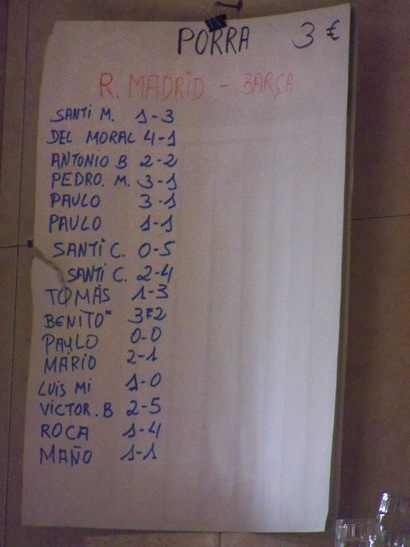 |
| This chart grew over the next few days, but Santi M. and Tomas were already to be winners. Visca Barça! |
The next day was spent in the mountains of south west Andorra, and after an 8km walk downhill, not only were we feeling it in our hips, we were also feeling it in our stomachs. While not eaten at Bar Turistic, this botifarra was magnificent: fresh sausage, white beans with some rosemary:
 |
| Botifarra at a locally-recommended place underneath the Andorran Ministry of Justice. |
But that was just a snack, because there were already more things we wanted to try at Bar Turistic! First off, the home made croquettes, a specialty of the house:
 |
| Chicken croquettes, also involving potatoes and maybe some cheese. |
 |
| Pintxo is a Basque word meaning "spike" and this meat was prepared and cooked on a skewer. |
Then something funny happened. One of the food staples here in Mallorca is pa amb oli, bread with oil, but also involving tomatoes, called pan amb tomàquet in Catalunya. First off, saying it in Mallorquìn was apparently kind of funny to the Andorran Catalan ear, and then, I made the comment, when it was suggested that we have some, that "we eat that all the time." This was interpreted as, "give us your best shot," at which point the proprietor was like, "well, how about tongue" and of course, we could not decline.
 |
| Pork tongue! |
This is now the second time in my life where tongue was presented as a challenge food. The first time was over a decade ago in Poland, when our tour guide complained that we were being served too much sausage, and they were like, "hahaha we'll show you, here's some tongue in green aspic!" I liked this dish, as the texture of the tongue was not completely offensive, and the sauce it was cooked in was delightful, along with some sauteed onions. However, I would probably not order and eat a whole portion myself.
The next, and last night, we had more croquettes, because they really were quite good, and some of this cod salad -- I wasn't expecting it to be cold, or a salad -- but it was really very refreshing, perfectly acidic, and just the right amount of salty, the way good cod should be.

I'm not sure if all of this is particularly "typical" Andorran food -- most of the "Made in Andorra" food there seemed to be cow- and cheese-centered -- but this is typical tapas, and the elements that needed to be present for it to be successful were there: homemade and good company with whom to share it.
07 November 2011
Els castellers de Mallorca
[This took place on 15 October - I had problems uploading the video, so I'm finally posting now.]
Already four years ago, in Tarragona, we saw this incredible sculpture of the castellers, and at the time I never thought I'd see the castellers in real life. As it turns out, the castells were declared as having UNESCO Intangible World Heritage protection status in 2010.
I got to the Plaça de Cort really early, which was good because I got a primo spot on some built-in benches of the Palma city hall, perfect for watching everything. The building itself is really rather interesting, because of the aforementioned built-in benches and an exaggeratedly large cornice, making it clear in 16-18th century architectural vernacular that it is a publicly-minded building.
The first to arrive, besides an old lady and me, was the ambulance crew.
Soon enough, people started to arrive wearing similarly-colored shirts, and then all of a sudden I started to hear shouting, chanting, then nasally-sounding instruments, and then gigants in motion! The castellers were coming down the street, en masse! The home team, Els Castellers de Mallorca, made a small castell, a pilar, and sent a kid up to the balcony of the city hall, the other two teams, els Al·lots de Llevant, and els Margeners de Guissona, also made pilars, and then the fun began with the castells.
In the video, you'll see the gigants leading the parade of castellers down the street. Gigants are huge puppets used during festive occasions all over the island, and each town seems to keep theirs on view in the city hall when not in use. The smaller demon gigant is especially used on Mallorca during the feast of Saint Anthony the Abbot on 17 January.
As they were parading up the streets, the castellers were also putting on their long black sashes, called faixa, which are like cumberbunds supporting their lower backs (important) and are also used as like stairs or footholds when people are climbing up the castell.
At the base of the castell is the pinya, the mass of people at the base. At the center, they are holding hands in a circle, and then each person behind them supports the arms of the person in front of them, and so on and so on:
 |
| The pinya forming |
I liked seeing this because I thought it was a lovely metaphor for the kind of world I want to live in, starting from the point that everyone is supporting each other, and people from the different teams join in to support the team who is actually making the tower. Everyone's prepared to get stepped on a little, and the tower might collapse, but they're all there to stay supportive to the end -- and the metaphor can keep going on and on and on. Maybe the video will inspire some continuations and/or variations of the metaphor.
In the meantime, there are instruments being played: a drum, and some grallas, which are double-reed instruments making the nasal-sounding accompanying music, called the toc - there are different songs for coming in, and the start of the music announces the start of the castell and seems to help create rhythm for the feat.
 |
| Playing the gralla |
The each of the three teams took turns making a castell, and then finally the home team made one last attempt:
This is really worth watching, because [spoiler alert] the tower collapses towards the end of the video. In real life, as on the video, it happened in slow motion, like it was expected but maybe it also would've been fine. What's also awesome is the end of the end - it's all still a celebration of success and above all, teamwork!
The next Wednesday, I was in the teacher's room at one of the schools where I teach, and I realized that one of my colleagues is a casteller. I was asking him about it, like why he did it (do you wake up one morning and decide you want to be a casteller?) and in addition to learning that the younger people in the middle sections of the tower are usually the ones who were at the top when they were smaller, meaning that everyone has years of practice doing this (they practice weekly) and there is a coordinating person. It's partly a cultural expression, and partly just a group of friends who hang out doing this every week. When I commented on the collapse, he said, "oh, people don't usually get hurt just a few bruises maybe. It's safer than playing football." I replied, "that's like saying it's safer to fly in a plane than it is to ride in a car." His response? "well, it is." But how many people can say that their hobby has UNESCO World Heritage status?
02 November 2011
November is a month for writing!
Writer types of people are perhaps already familiar with November as NaNoWriMo, and of course it's Movember, but it's also the 30 Days of Independent Travel Project! Hopefully it will help me to articulate some of the thoughts and feelings I've been having lately about travel.
The first prompt was about goals, and really, right now, I don't have any huge travel goals. What I'd like to make some comments on is ch-ch-ch-change.
In the last year, I've become a lot less resistant to the idea of using a backpack as a way of carrying things while I travel. This is directly attributable to the Hadrian's Wall Path trip, out of efficiency and necessity. During my formative years in Rome, I would see people with outrageously huge packs wearing flipflops (can't be good for your feet) arguing in front of the ticket windows in Termini, and it just didn't seem like the kind of traveler I wanted to be. So for years, I tried to project a more business-like, jet setter look with a black carry-on roller suitcase, which can be fine for intercity travel but is obviously impractical for tromping through sheep fields in Northern England. When you stop and think about it, it's also impractical for the incredibly unevenness of urban streets, as well.
Most of my distaste for backpacks comes from trips staying in youth hostels and sleeping in the back of a Volkswagen Eurovan with my parents in the early 1990s. My reactionary travel style developed into a sort of middle ground, trying to seem as normal and cultured as possible while still keeping the budget low. This usually ends up meaning means private rooms with shared bathrooms as accommodations and using a carry-on wheelie suitcase, and doesn't go much further. Lately, I've also been thinking about how much the internet has changed the way we travel - comparison-shopping for flights and hotels, and I'm addicted to TripAdvisor reviews to give myself the sort of experience I want and expect to have.
Though the Hadrian's Wall Path trip caused me to go and buy a backpack, spending so much time on trains in Slovakia is what softened me to the idea. Students traveling to and from Bratislava on weekends use big backpacks like I'd see in Roma Termini, and they clearly were also not backpackers. Yet, as I plan and do more and more independent travel, and I think back on various journeys, really, deep down, I'm more of a backpacker than I'm often willing to admit -- and I couldn't do what I do otherwise. I've picked up skills, habits and tolerances (making choices as an adult, not as a 4 year old, though that certainly helped!) doing this style of travel in Europe that have been making me dream of Megabusing it all over America (really? yes.) and I think I can accept the greater self-awareness and especially self-acceptance:
The first prompt was about goals, and really, right now, I don't have any huge travel goals. What I'd like to make some comments on is ch-ch-ch-change.
In the last year, I've become a lot less resistant to the idea of using a backpack as a way of carrying things while I travel. This is directly attributable to the Hadrian's Wall Path trip, out of efficiency and necessity. During my formative years in Rome, I would see people with outrageously huge packs wearing flipflops (can't be good for your feet) arguing in front of the ticket windows in Termini, and it just didn't seem like the kind of traveler I wanted to be. So for years, I tried to project a more business-like, jet setter look with a black carry-on roller suitcase, which can be fine for intercity travel but is obviously impractical for tromping through sheep fields in Northern England. When you stop and think about it, it's also impractical for the incredibly unevenness of urban streets, as well.
Most of my distaste for backpacks comes from trips staying in youth hostels and sleeping in the back of a Volkswagen Eurovan with my parents in the early 1990s. My reactionary travel style developed into a sort of middle ground, trying to seem as normal and cultured as possible while still keeping the budget low. This usually ends up meaning means private rooms with shared bathrooms as accommodations and using a carry-on wheelie suitcase, and doesn't go much further. Lately, I've also been thinking about how much the internet has changed the way we travel - comparison-shopping for flights and hotels, and I'm addicted to TripAdvisor reviews to give myself the sort of experience I want and expect to have.
 |
| A bit sunburnt, too! |
Hello, my name is Maria, and I am a backpacker.
01 November 2011
Table Wine Marketing and Customer Loyalty
Last week, I walked into the school office because I had some paperwork to complete, and the two guys in the office were discussing their sandwich choices for the mid-morning snack. I think it was only about 9am. After my first class, I had two hours break, so I went to the cafe down the street for a much-needed coffee.
The cafe was busy, it's a nice local place and I've gone there often enough that the waiter has begun to recognize me. Apparently they also serve the best frito mallorquin in the port, which I've yet to sample, but I can vouch for their coffee and sandwiches. Anyway, in a busy cafe, and not just this one, I'd noticed that there are half-full bottles everywhere, and then in the afternoon they live on a sideboard in the restaurant. Same thing at the cafe on the other side of the port where I often go with colleagues from the other school where I teach.
When I got back to school, I asked the guys in the office about this - because all over the cafe, there were open bottles of wine, and in a few cases, liquor, on the tables. I've never seen anything like it, and how do they figure out how to pay? As it turns out, this is a local custom that is meant to help build customer loyalty. See, the bottle of wine, because it's just table wine (though obviously drinkable), costs maybe 2 or 3 Euro. If they charge a Euro a glass, they'll make the cost of the bottle back fine, and it all evens out (though that attitude on a large scale may be what's causing the economic situation we're finding ourselves in here in the Mediterranean states). The same goes for people who like to put a bit of liquor in their coffee; people like to put their own in because it makes them feel like they're trusted customers, and it all evens out and the cafe still makes a profit.
The guys in the school office compared it to the bottomless cup of coffee in American restaurants, with the interjection, "but how could you drink that stuff anyway? One cup of that and I'd be straight to the bathroom!" Here in Mallorca, it's just snack time, a glass of table wine, and 'marketing'.
The cafe was busy, it's a nice local place and I've gone there often enough that the waiter has begun to recognize me. Apparently they also serve the best frito mallorquin in the port, which I've yet to sample, but I can vouch for their coffee and sandwiches. Anyway, in a busy cafe, and not just this one, I'd noticed that there are half-full bottles everywhere, and then in the afternoon they live on a sideboard in the restaurant. Same thing at the cafe on the other side of the port where I often go with colleagues from the other school where I teach.
When I got back to school, I asked the guys in the office about this - because all over the cafe, there were open bottles of wine, and in a few cases, liquor, on the tables. I've never seen anything like it, and how do they figure out how to pay? As it turns out, this is a local custom that is meant to help build customer loyalty. See, the bottle of wine, because it's just table wine (though obviously drinkable), costs maybe 2 or 3 Euro. If they charge a Euro a glass, they'll make the cost of the bottle back fine, and it all evens out (though that attitude on a large scale may be what's causing the economic situation we're finding ourselves in here in the Mediterranean states). The same goes for people who like to put a bit of liquor in their coffee; people like to put their own in because it makes them feel like they're trusted customers, and it all evens out and the cafe still makes a profit.
The guys in the school office compared it to the bottomless cup of coffee in American restaurants, with the interjection, "but how could you drink that stuff anyway? One cup of that and I'd be straight to the bathroom!" Here in Mallorca, it's just snack time, a glass of table wine, and 'marketing'.
folding bicycles, an infatuation story

Here's my sweet little vintage folding bike, which I love and already know I will have trouble parting with. It's a now-defunct Basque brand, GAC (Garate, Anitua y Cia). When I took it into a workshop because the front tube needed replaced, the guy pointed at all of the other bikes he had available as rentals, and commented on how this one's like new and he has to replace the rentals annually.
I might add that the photo doesn't do it justice because it doesn't show the chain guard and glorious crank case as well as it could. Doing some internet-based reconnaissance, I realize I acquired it for a steal, considering its condition, and if I was serious at all, I probably wouldn't be using it for daily use -- but then what fun would it be? It has front and back lights which work with a little motor that engages onto the front wheel, carries my groceries well and it's becoming recognizable around town.
It reminds me of this Eska I spotted this summer in Nová Sedlica:

Because really, for all that we speak of mid-century modern design, which can be all sexy and jet-setty and Corbusian and all kinds of adjectives I love, this is it. These bicycles are the epitome of European mid-century modern, because they embody the post-war European working class -- we've moved on from Ladri di biciclette, now this is something everyone can have and afford, and in a sense the only thing that makes these bicycles special now is that they still exist. What I also like is that while these bikes are on the surface opposites: fascist/communist, Basque/Zemplín, red/blue, etc they're essentially the same folding bike (though the GAC has some lovely bourgeois curves) to be sold to the same people at the same time, just in different places.
My soft spot for this style of bicycles comes from a delightful ride along the Barceloneta back in 2007 -- back home, I've got a steel Chinese-made model from my university years, and I'm looking forward to even more delightful rides with this one.
Cap de Formentor and Talaia d'Albercutx
The day we went to Cap de Formentor, it was overcast, wanting to rain, creating the drama of the Mediterranean in the autumn and winter. This is one of the most famous areas of the island, and it certainly didn't disappoint.
Farther up the windy road (built by an Italian) from the Mirador de Mal Pas is the Talaia d'Albercutx, which I can see from my window. I've seen it described elsewhere by an English person as a "pepper pot" but this short article is really worth a read for the history of watch towers on Mallorca.
Going up to the top of the watch tower requires climbing a wire rung ladder to a middle level and then up another and some scrambling through a hole in the floor to get to the top level. It's the sort of unregulated, slightly unsafe historic European thing that would never happen in the US for fear of lawsuits, which is of course what makes it so fun and also slightly terrifying.
The highlight were the wild goats everywhere, of whom sadly I was unable to catch a good photograph.
 |
| This picture was taken from ~300m above sea level. |
 |
| On the way up to the watchtower, there's ruins of an abandoned project of some kind, with the accompanying street art. This one declares that we're on liberated land. |
 |
| And at the top of the tower, proof of Roma caput mundi. |
Tots Sants
Today is one of my favorite holidays (see here), perhaps because of how understatedly visceral it is. Further, cemeteries are one of the most interesting places to visit in a new place -- they say so much about the customs and traditions of the locals, which is especially meaningful here, where sometimes the locals are hard to spot. You can tell how special a day it is when even Lidl, which is open Sundays, is closed for the holiday today.
Little Spanish ladies dressed in black, in the way that you know they're in mourning clothes because it's not quite a chic look. Others dressed in work clothes carrying buckets and brooms into the cemetery so that they can clear off the tombstones to get them ready for the new flowers.

I didn't expect the cemetery to be so paved. There was no space in the cemetery for anything to be planted, everything is covered in stone. There were some beautiful statues and even more beautiful typography on the stones.

The fall flowers were beautiful, lots of mums but also lots of gladiolas. It makes me remember the defiantly red gladiolas on Antonio Gramsci's grave last time I was in the Protestant Foreigner's Cemetery in Rome, quite possibly my favorite cemetery I've yet been to. Here, what was missing was the candles - which truly do add more visceral layers to the experience - but we had the sun, so no complaints.
This feast makes me wonder why we don't really celebrate it this way so much in America - quite possibly the commercialism of Halloween does truly eclipse it, and it's really too bad, because this is what it's about.
Little Spanish ladies dressed in black, in the way that you know they're in mourning clothes because it's not quite a chic look. Others dressed in work clothes carrying buckets and brooms into the cemetery so that they can clear off the tombstones to get them ready for the new flowers.

I didn't expect the cemetery to be so paved. There was no space in the cemetery for anything to be planted, everything is covered in stone. There were some beautiful statues and even more beautiful typography on the stones.

The fall flowers were beautiful, lots of mums but also lots of gladiolas. It makes me remember the defiantly red gladiolas on Antonio Gramsci's grave last time I was in the Protestant Foreigner's Cemetery in Rome, quite possibly my favorite cemetery I've yet been to. Here, what was missing was the candles - which truly do add more visceral layers to the experience - but we had the sun, so no complaints.
This feast makes me wonder why we don't really celebrate it this way so much in America - quite possibly the commercialism of Halloween does truly eclipse it, and it's really too bad, because this is what it's about.
17 October 2011
El pueblo unido jamás será vencido
"The people, united, will never be defeated."
[I wrote this right after the 15O protests, and am publishing it on 7 Nov 2011. The last few weeks, with continued politics in Europe deriving from and influencing the credit crisis, and notable events in Oakland, CA, only confirm to myself what I've written and thought about this already.]
For the last few days, I've been thinking about how to discuss Saturday night in such a way so as to share what I did and why, and also to respect the possibly divergent views some of my loyal readers might have. Then today, the NYT Architecture critic Michael Kimmelman gave me the answer:
The other important part of the social contract is an inherent respect for others -- the communists present did not beat up on the socialists over the differences they may have on the distribution of wealth. Folks recognize what they have in common, and get together to help make a step in the direction of the world they want to live in, myself included. These demonstrations are not monoliths, they're many different groups of people who get together to help each other make their voices even louder.

For the last few days, I've been thinking about how to discuss Saturday night in such a way so as to share what I did and why, and also to respect the possibly divergent views some of my loyal readers might have. Then today, the NYT Architecture critic Michael Kimmelman gave me the answer:
It's something I've internalized for the last 10 or so years of my life, and the idea of "the European social compact" is something I've been thinking about intensely for the last few months (because a lot of my life is balancing between European and American social contracts) without knowing exactly how to verbalize it.
I remember when we first moved to Rome, 11 years ago - back then people were angry about most of the same things, but it was a more anti-corporate vibe, whereas now it's a much more anti-banks, anti-financial institutions vibe, and one that seems to me to be more accurately placed. Simply speaking, if I want a cell phone or computer or most other consumer goods without making things really difficult for myself, I've got to get them from some huge multinational corporation, so choices have to be made and usually the market supports that. On the other hand, the sort of actions banks and other financial institutions have been making over the last 30+ (100+, 500+) years has helped us get to that point while they have stolen money from just about everyone possible - us, and the governments they bought that are supposed to also represent us.
Anyway, I remember when I saw my first march of ~20,000 communists walking down Via Barberini (strange place for a march, I know, but that's where they were that day) and I almost peed my pants, I was so scared because I thought, "Oh no! The communists! And there's so many of them!" Meanwhile, other people around paid no attention and went about with their business - and in the last 11 years, communists have not taken over Italy or anywhere else, really - not a threat, and yet the fight continues. Then September 11 happened and I remember standing in Piazza del Popolo around significantly fewer members of Italy's right wing parties in solidarity with the USA (a strange experience, mostly because of the creepster neo-Fascists present), and a few years after that, I demonstrated for peace in Oakland (before Schenley Plaza was built and gained notoriety during the G20) and Central Park, and then the great Rally to Restore Sanity on the Mall in DC, and Kimmelman's point is proved. These spaces are integral to our public conversation.
Yesterday, in Palma, I had a cortado (read: espresso macchiato) while sitting on a bench the Passeig de Born. A few hours later, it would be filled with 20,000+ people who were united for #globalchange, and then, just a few hours after that, back to normal again. Nothing got broken, no one got harrassed - back to that old European social contract.
The other important part of the social contract is an inherent respect for others -- the communists present did not beat up on the socialists over the differences they may have on the distribution of wealth. Folks recognize what they have in common, and get together to help make a step in the direction of the world they want to live in, myself included. These demonstrations are not monoliths, they're many different groups of people who get together to help each other make their voices even louder.

The atmosphere was pretty much a party, because of the Drums for Peace, which also set a rhythm for the march, there were songs and dancing and it was a warm, autumnal Saturday evening so we were all out for a nice walk! But do not misunderstand a party-like atmosphere for this being taken lightly - except there's so much to celebrate: our humanity, being alive, being together, and our shared convictions. Spain has gotten plenty of practice lately in this sort of thing, because of and from the 15M movement -- and in a lot of ways, this was an extension of that, because the problems have still yet to receive an adequate solution and so truth must continue to be spoken to power. This demonstration had it all - the communists, socialists, anarcho-syndicalists, grandmothers, kids in strollers, middle-aged folks blowing whistles and some awesome Adbusters-inspired street theatre weaving through the crowds. As public buses passed, drivers honked in solidarity, causing us all to make sure the driver could hear our thanks. Now might also be a good time to add that there were posters for this demonstration at both of the schools where I teach, and I actually ran into a colleague there! So, this is not a movement of a bunch of hippies - it's people who look like you and me, who work for an honest living, and who actively participate in the democratic process.
There were some great slogans and chants, again, many carried over from 15M, and responding to the huge amounts of money that is being siphoned away from taxpayers everywhere, as we're coming to find out. For example: "No hay pan por tanto chorizo [there's not bread for so much chorizo, meaning thievery in addition to sausage]" and "Manos arriba, esta es un atraco [hands up, this is a robbery]!" And another: "Si no nos dejan soñar, no os dejaremos dormir [If you won't let us dream, we won't let you sleep]". And another: "Protesta como un ciudidano o calla como un servo [Protest like a citizen or shut up like a servant]".
The police were pretty unobtrusive and mostly were there to serve as traffic cops, but as we were walking from Plaça Rei Joan Carle I up the Avinguda Jaume I, I realized real fast what a terrorizing tactic kettling could be. I think my American experiences (seeing mounted police, riot police, plain clothes police - thankfully only using intimidation tactics when I've been present) made me way edgier than 99% of the people there, and I was jealous of that -- how wonderful that so many families were there with small children, so many older people walking with canes, and so obviously unworried about any potential violence -- there's our social contract again, that the police are there to protect the demonstrators, not others from the demonstrators.

Towards the end of the march, we, following one of the themes of the march to "toma el calle [take the streets]" we sat down on the pavement in the street for a while, then got up and ended with a rally of sorts in Plaça Espanya, where I got to see the street theatre up close:
 |
| Adbusters-inspired street theatre, with actors representing various negative aspects of capitalism (military spending, education cuts, etc) being pushed in shopping carts by zombie televisions |
After getting some real, cut-with-scissors-and-weighed-by-an-Italian pizza a taglio, I was able to catch the end of the ball de bot across the street in the Parc de ses estacions. There, the castellers were grilling meats on public grills, with public tongs chained to said grills. A European socialist paradise, indeed!
16 October 2011
The Price of Water
I'm hard at work preparing two posts about Saturday, which will be finished as soon as my videos upload to YouTube. In the meantime, a quick thought about price fluctuations and/or comparison shopping in real life, because I've never been anywhere where the differences were so obvious.
Here, it's recommended to use bottled water for drinking and cooking, because there is so much calcium in the tap water -- it's nothing bad, in fact it could be quite good, and I use the bottled water mostly for coffee. One jug lasts me a week.
But since I live in tourist central, buying something as simple as 6L of water is a classic situation of supply, demand and convenience. Between my house and work, there's a Lidl - a European discount grocery store very similar to Aldi - where I buy most of my groceries. However, it's a bike ride away and I try to maximize what I can carry with me in my backpack and on the bike rack - water would take up too much space and weight. In the basement of my building, there's a Spar - basically, a convenience store, and about a block down the street, a larger, independently-owned-but-catering-to British-tourists small grocery store. Up and down my street, there are about 5 or 6 Spars.

All three of these waters are bottled from two places here in Mallorca.
On the left, purchased at the Spar in my building, 5L of water for €1.98.
In the middle, purchased down the street, 6L of water for €0.99.
On the right, purchased farther down the street on the main road, 1.5L of water for €1.50 - same water as the one on the left.
Sometimes, the stuff at the place down the street is less, or the same price as Lidl. I buy my coffee and a few other things in Palma because I've had to be there for something else and it was convenient and less expensive to grocery shop there than ride my bike farther to other normal-priced grocery stores nearby.
This isn't about bottled water being fancy, nor is it about how easy it could be to rip off tourists - it's mostly about how sometimes, bulk is cheaper and there are questions of convenience involved. The same goes for the type of cream I use in my coffee, the baguettes I buy for bread, and the ready-made gazpacho that's so refreshing and healthy; it's just been a long time since I can remember being somewhere where the differences in price were so considerably obvious.
Here, it's recommended to use bottled water for drinking and cooking, because there is so much calcium in the tap water -- it's nothing bad, in fact it could be quite good, and I use the bottled water mostly for coffee. One jug lasts me a week.
But since I live in tourist central, buying something as simple as 6L of water is a classic situation of supply, demand and convenience. Between my house and work, there's a Lidl - a European discount grocery store very similar to Aldi - where I buy most of my groceries. However, it's a bike ride away and I try to maximize what I can carry with me in my backpack and on the bike rack - water would take up too much space and weight. In the basement of my building, there's a Spar - basically, a convenience store, and about a block down the street, a larger, independently-owned-but-catering-to British-tourists small grocery store. Up and down my street, there are about 5 or 6 Spars.

All three of these waters are bottled from two places here in Mallorca.
On the left, purchased at the Spar in my building, 5L of water for €1.98.
In the middle, purchased down the street, 6L of water for €0.99.
On the right, purchased farther down the street on the main road, 1.5L of water for €1.50 - same water as the one on the left.
Sometimes, the stuff at the place down the street is less, or the same price as Lidl. I buy my coffee and a few other things in Palma because I've had to be there for something else and it was convenient and less expensive to grocery shop there than ride my bike farther to other normal-priced grocery stores nearby.
This isn't about bottled water being fancy, nor is it about how easy it could be to rip off tourists - it's mostly about how sometimes, bulk is cheaper and there are questions of convenience involved. The same goes for the type of cream I use in my coffee, the baguettes I buy for bread, and the ready-made gazpacho that's so refreshing and healthy; it's just been a long time since I can remember being somewhere where the differences in price were so considerably obvious.
04 October 2011
Fira d'Alcúdia
Wow, what a way to have a first experience of this town!
The annual fair of Alcúdia was this weekend, and when I saw 'ball de bot' on the schedule for tonight + determined what it was, I was sold. The event overall is a fair with artisans, local products and food in a bucolic, perfectly Mediterranean-textured historic town with undulating tufa walls and majolica street signs.
I can't find my thingy to get the pics off of my camera, so I'm going to have to edit this post to add pictures...
After walking around a bit, I decided I was hungry enough to grab some tapas, and I got some frito mallorquín - a classic meat and potatoes dish, with fennel greens and roasted red peppers. As I was eating it, I was having a hard time determining the meat, because there was a lot of liver texture happening, but not every piece was liver-y (and it was really well-cooked liver - it's a fine line). Turns out, the recipe calls for both lamb and lamb liver, so I was half right. I washed this goodness down with a beer and continued to enjoy walking around, also waiting for the dancing to start.
Reading up on this, I realized I missed els gegants - these massive puppets that I saw around the square - apparently they make them dance too!
But really the highlight of the evening was the dancing. Though my girl Emma never actually said it, "If I can't dance I don't want to be part of your revolution." Tonight reminded me of seeing the sardanes in Barcelona, except with better music, and also of many nights singing and dancing in the Carpathians, because there I'm able to participate more naturally. Any planned spontaneous expression of folk culture is so authentic and vibrant -- I cried watching this tonight, it was so amazing. Besides the good boleros and happy people, the greatest thing was that authentic folk culture was articulated through dance, in a popular and natural format. Like doing the sardanes or čardaš, how better to assert identity and 'advertise' traditional cultures, especially as a minority, than with dance?
The ball de bot is like a flash mob every time a dance starts -- people mill around the square clicking their castanets and then the music starts up and immediately a graceful pool of movements begins. It's a bit like kolo dancing maybe, as you don't have to have a partner, but you can, and it's circles of all ages, kids learning by watching and joining in, and lots of people absolutely grinning from ear to ear with obvious pleasure:
Sometimes they line up in rows, sometimes they're in circles - either way, there's plenty of opportunity to witness authentic electricity firing around among the dancers.
Right as I was leaving they busted out the bagpipes, shame I didn't catch more of them.
The annual fair of Alcúdia was this weekend, and when I saw 'ball de bot' on the schedule for tonight + determined what it was, I was sold. The event overall is a fair with artisans, local products and food in a bucolic, perfectly Mediterranean-textured historic town with undulating tufa walls and majolica street signs.
I can't find my thingy to get the pics off of my camera, so I'm going to have to edit this post to add pictures...
After walking around a bit, I decided I was hungry enough to grab some tapas, and I got some frito mallorquín - a classic meat and potatoes dish, with fennel greens and roasted red peppers. As I was eating it, I was having a hard time determining the meat, because there was a lot of liver texture happening, but not every piece was liver-y (and it was really well-cooked liver - it's a fine line). Turns out, the recipe calls for both lamb and lamb liver, so I was half right. I washed this goodness down with a beer and continued to enjoy walking around, also waiting for the dancing to start.
Reading up on this, I realized I missed els gegants - these massive puppets that I saw around the square - apparently they make them dance too!
But really the highlight of the evening was the dancing. Though my girl Emma never actually said it, "If I can't dance I don't want to be part of your revolution." Tonight reminded me of seeing the sardanes in Barcelona, except with better music, and also of many nights singing and dancing in the Carpathians, because there I'm able to participate more naturally. Any planned spontaneous expression of folk culture is so authentic and vibrant -- I cried watching this tonight, it was so amazing. Besides the good boleros and happy people, the greatest thing was that authentic folk culture was articulated through dance, in a popular and natural format. Like doing the sardanes or čardaš, how better to assert identity and 'advertise' traditional cultures, especially as a minority, than with dance?
The ball de bot is like a flash mob every time a dance starts -- people mill around the square clicking their castanets and then the music starts up and immediately a graceful pool of movements begins. It's a bit like kolo dancing maybe, as you don't have to have a partner, but you can, and it's circles of all ages, kids learning by watching and joining in, and lots of people absolutely grinning from ear to ear with obvious pleasure:
Sometimes they line up in rows, sometimes they're in circles - either way, there's plenty of opportunity to witness authentic electricity firing around among the dancers.
Right as I was leaving they busted out the bagpipes, shame I didn't catch more of them.
Subscribe to:
Posts (Atom)